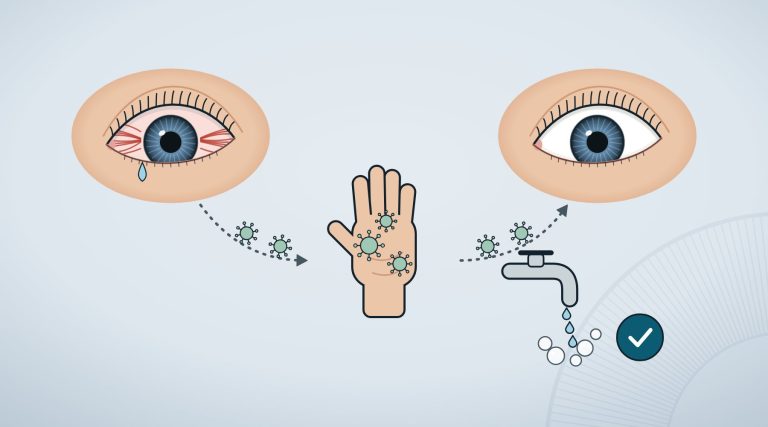
The phone rings in mid-morning, and it is the nursery: ‘Your child has a red, sticky eye, please come and pick them up.’ For many parents it is a familiar scene, and not by chance. A British study estimates that every year one school-age child in eight has an episode of infectious conjunctivitis1.
Behind that phone call lie three questions: is it a virus or bacteria? Is an antibiotic eye drop needed? When can they go back to class? On the first two, the studies have fairly clear answers. On the third, far less so.
In brief
- Infectious conjunctivitis is very common in the early years: in Dutch family doctors’ data, children under one year of age had over 80 episodes per 1,000 a year, against 14 in the general population2.
- In children bacterial forms predominate, with thick discharge and stuck eyelids; viral ones cause burning and watery tears3,4.
- In a study of 326 children, within seven days 83% of those using a placebo eye drop and 86% of those using an antibiotic eye drop were better1.
- The rules on returning to nursery or school vary greatly from place to place, and studies have not clarified how much keeping children at home reduces infections7,8.
- In a newborn baby conjunctivitis is a separate case and must always be assessed by a doctor4,9.
In this article
Why children get it so often
The most solid figures come from family medicine. In 2001, in the Netherlands, all the contacts between 195 family doctors and their 375,899 patients were analysed over a full year: there were 5,213 episodes of infectious conjunctivitis, about 14 per 1,000 people a year. In children up to one year of age, however, they exceeded 80 per 1,000; after the age of four they fell below 122. A 2008 review estimates that bacterial conjunctivitis alone accounts for about 1% of all general practice consultations7.
How these infections pass from one person to another, and why hands matter so much, we explain in our article on how conjunctivitis is transmitted.
Conjunctivitis in children: bacteria or virus?
Unlike what happens in adults, in children bacterial conjunctivitis is the most common3,4. A 2023 paediatric review describes the three main forms as follows3:
- bacterial: thick, yellowish discharge, stuck eyelids;
- viral, caused mainly by adenovirus: burning, a feeling of grit in the eyes, watery tears;
- allergic, largely seasonal: itching in both eyes and watery discharge.
In practice, however, telling bacteria from a virus just by looking at the eye is difficult, and reviews have stressed this for years7. The differences between the three forms are described in our article on viral, bacterial or allergic conjunctivitis.
Antibiotics or not: the studies in children
The study
A study of 326 children and an eye drop
In the United Kingdom, 12 general practice surgeries enrolled 326 children aged between 6 months and 12 years with infectious conjunctivitis. Half received an antibiotic eye drop (chloramphenicol), half an identical eye drop without the medicine; neither the families nor the doctors knew which. Parents recorded the symptoms in a diary and the children were followed for six weeks. By the seventh day 86% of the children treated with the antibiotic and 83% of those with the placebo were better: a small difference, within the study’s margin of uncertainty. New episodes in the following six weeks were seen in 4% of the children on the antibiotic and 3% of those on the placebo, and undesirable effects were rare in both groups. The authors’ conclusion: most children with infectious conjunctivitis seen by the family doctor get better on their own and do not need the antibiotic1.
A more recent Finnish study, carried out in Oulu between 2014 and 2020, divided 88 children aged between 6 months and 7 years into three groups: antibiotic eye drop, placebo eye drop, no eye drop. With the antibiotic the symptoms disappeared on average in 3.8 days, with no eye drop in 5.7: about two days fewer. Even the placebo eye drop, curiously, shortened the time compared with no treatment. The same authors then pooled four studies with 584 children: with antibiotics, the proportion of children still with symptoms between the third and the sixth day was lower than with the placebo5.
The picture is consistent with the 2023 Cochrane review, which examined 21 studies, not only in children: antibiotic eye drops speed up resolution modestly, with evidence of moderate certainty6. A paediatric review suggests deciding case by case, because the antibiotic can shorten the symptoms but is not free of risks3; another notes that ‘delayed’ prescribing, to be used only if the symptoms do not improve, controls symptoms in a similar way to immediate prescribing4. In practice, however, antibiotics are used a great deal: in the Dutch data a local treatment for the eye was prescribed in 87% of episodes, and in 80% of cases it was an antibiotic2.
Nursery and school: at home or in class?
Here the evidence is scarce, and the rules vary. A study of the 60 nurseries in a region of Israel found that 83% sent home children with eye discharge or conjunctivitis, and almost half asked for a medical certificate for their return; but about half of the nurseries decided on the basis of ‘common sense’ and personal feelings, not official guidance8. It is a single country and a twenty-year-old study; but in Europe too the rules change from one country to another, and often from one school to another. Ask the paediatrician and the school how it works where you live.
Then there is a knot that the studies have not untied. A 2008 review observes that the antibiotic is often prescribed also because it allows children to return to nursery or school sooner, but that the effect of prescribing fewer antibiotics on the transmission of germs remains to be clarified7. The Cochrane review too stresses that a faster recovery matters for returning to school or work6. In the meantime, the measure recommended by the reviews is hygiene, starting with frequent hand washing4.
Newborn babies: a separate case
In the first weeks of life conjunctivitis, also called ophthalmia neonatorum, has different causes and risks. At a children’s hospital in Dublin, between 2013 and 2018, 54 cases were studied: the most frequent cause was chlamydia (20.4%), followed by Staphylococcus aureus (18.5%) and Haemophilus influenzae (14.8%). Half of the babies were admitted to hospital and almost one in two received intravenous antibiotics9. A 2022 review notes that some of these infections can cause complications throughout the body, and that the prophylaxis given at birth in some countries does not protect against all the causes10. For this reason the reviews recommend that conjunctivitis in a newborn baby should always be assessed4.
When to talk to an ophthalmologist
- A newborn baby with red or swollen eyes, or with discharge: must always be seen by a doctor, promptly4,9.
- Severe pain, or a child who seems to see less well4. If the symptoms are sudden and severe, call 112 or go to an emergency department (A&E); you will find the other warning signs on our page about eye emergencies.
- Teenagers who wear contact lenses: conjunctivitis must be assessed by the ophthalmologist, to rule out a corneal ulcer3.
- Blisters on the eyelids or nose, or a child with a weakened immune system4.
- If there is no improvement after a week: most children are already better by then1.
Frequently asked questions
Can a child with conjunctivitis go to nursery?
It depends on the rules of the place, which vary greatly between countries and between settings8. Studies have not clarified how much keeping children at home reduces infections7. Washing hands often remains the recommended measure for reducing transmission4.
Does conjunctivitis in children clear up on its own?
In most cases it does. In the British study of 326 children, 83% of those treated with a placebo were better within seven days1.
Why does the paediatrician sometimes not prescribe the antibiotic eye drop?
Because the benefit is modest: a few days fewer of symptoms, according to the studies1,5,6. One possibility that has been studied is ‘delayed’ prescribing, to be used only if the symptoms do not improve4; and the antibiotic, like any medicine, is not free of risks3.
Is conjunctivitis in a newborn baby dangerous?
It can be, more than in older children: some of the causes can cause complications throughout the body10. In the Dublin study the most frequent cause was chlamydia, and half of the babies were admitted to hospital9.
Conjunctivitis is one of the most common complaints of childhood and, in most cases, clears up on its own within a week1. The studies say that the antibiotic shortens the time a little, that the rules on nursery and school are more a local habit than the fruit of evidence, and that one exception must always be taken seriously: that of the newborn baby.
Sources
- Rose PW, Harnden A, Brueggemann AB, Perera R, Sheikh A, Crook D, et al. Chloramphenicol treatment for acute infective conjunctivitis in children in primary care: a randomised double-blind placebo-controlled trial. Lancet. 2005;366(9479):37-43. doi:10.1016/S0140-6736(05)66709-8 · PubMed 15993231
- Rietveld RP, ter Riet G, Bindels PJ, Schellevis FG, van Weert HC. Do general practitioners adhere to the guideline on infectious conjunctivitis? Results of the Second Dutch National Survey of General Practice. BMC Fam Pract. 2007;8:54. doi:10.1186/1471-2296-8-54 · PubMed 17868475 · PMC
- Mahoney MJ, Bekibele R, Notermann SL, Reuter TG, Borman-Shoap EC. Pediatric Conjunctivitis: A Review of Clinical Manifestations, Diagnosis, and Management. Children (Basel). 2023;10(5). doi:10.3390/children10050808 · PubMed 37238356 · PMC
- Winters S, Frazier W, Winters J. Conjunctivitis: Diagnosis and Management. Am Fam Physician. 2024;110(2):134-144. PubMed 39172671
- Honkila M, Koskela U, Kontiokari T, Mattila ML, Kristo A, Valtonen R, et al. Effect of Topical Antibiotics on Duration of Acute Infective Conjunctivitis in Children: A Randomized Clinical Trial and a Systematic Review and Meta-analysis. JAMA Netw Open. 2022;5(10):e2234459. doi:10.1001/jamanetworkopen.2022.34459 · PubMed 36194412 · PMC
- Chen YY, Liu SH, Nurmatov U, van Schayck OC, Kuo IC. Antibiotics versus placebo for acute bacterial conjunctivitis. Cochrane Database Syst Rev. 2023;3(3):CD001211. doi:10.1002/14651858.CD001211.pub4 · PubMed 36912752 · PMC
- Høvding G. Acute bacterial conjunctivitis. Acta Ophthalmol. 2008;86(1):5-17. doi:10.1111/j.1600-0420.2007.01006.x · PubMed 17970823
- Kahan E, Gross S, Cohen HA. Exclusion of ill children from child-care centers in Israel. Patient Educ Couns. 2005;56(1):93-7. doi:10.1016/j.pec.2003.12.012 · PubMed 15590228
- Gildea D, Goetz R, Drew R, Chamney S. Ophthalmia neonatorum in a tertiary referral children’s hospital: A retrospective study. Eur J Ophthalmol. 2022;32(1):587-591. doi:10.1177/1120672121994734 · PubMed 33583215
- Khan A, Anders A, Cardonell M. Neonatal Conjunctivitis. Neoreviews. 2022;23(9):e603-e612. doi:10.1542/neo.23-9-e603 · PubMed 36047752
Study titles are given in their original language of publication. The superscript numbers in the text refer to these sources; citation details come from PubMed (National Library of Medicine).