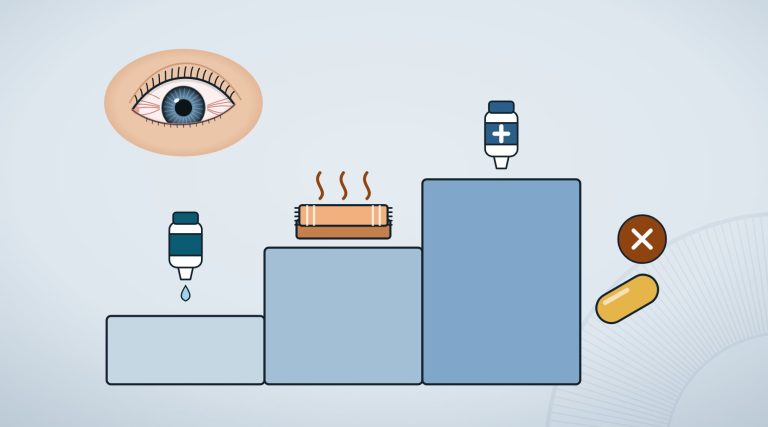
Just ask a search engine how to improve your eyesight naturally and you will find everything: exercises to do every morning, diets based on carrots and berries, supplements, methods that promise to set your glasses aside in a few weeks. The idea is attractive: if muscles can be trained and the body nourished, why shouldn’t the same go for the eyes?
False, if by eyesight we mean the sharpness with which we see: studies have found no exercises or supplements able to reduce a vision defect or to make the eyesight of healthy eyes sharper1,2,3. True, though, that some choices really do matter. They are just not the ones in the adverts.
In brief
- Eye exercises have shown no clear benefits on myopia or visual acuity1,2.
- In meta-analyses of randomised trials, multivitamins gave no benefits on visual acuity3.
- According to a Cochrane review of over 76,000 people, vitamin E and beta-carotene neither prevent nor delay the onset of macular degeneration4.
- What makes the difference is correcting vision defects: in 2020, worldwide, 157 million people saw poorly because of an uncorrected defect5.
- In children, more time outdoors reduces the onset of new myopia7,8.
In this article
Exercises: many promises, little evidence
A systematic review of eye exercises listed the benefits attributed to them, from myopia to visual acuity, from eye strain to dyslexia. The evidence mainly supported the treatment of a specific near-vision disorder, convergence insufficiency; for myopia and sharpness of vision there was no clear scientific evidence1. A 2024 meta-analysis of 11 studies and 921 participants concluded that eye exercises have limited or no efficacy on myopia2. We tell the story of the best known of these methods in Eye exercises and the Bates method: do they work?
Food and supplements
Supplements are the ‘in capsules’ version of the natural promise. A 2026 review that brought together 19 meta-analyses of multivitamins with minerals found no benefit on visual acuity in randomised trials, and also reported a higher risk of progression of macular degeneration3.
For age-related macular degeneration the most solid evidence is a 2017 Cochrane review: five randomised trials, conducted in Australia, Finland and the United States, with data on 76,756 people followed for an average of between 4 and 12 years. Vitamin E and beta-carotene neither prevented nor delayed the onset of the disease; the same is probably true of vitamin C and of the multivitamin studied. For other antioxidants, such as lutein and zeaxanthin, there is no evidence either way4.
And ‘natural’ does not mean harmless. In the same review one study recorded more haemorrhagic strokes with vitamin E (39 against 23, low-certainty evidence), and beta-carotene increases the risk of lung cancer in smokers4. For people who already have macular degeneration the discussion is different, and we cover it in the article on AREDS supplements. As for diet, observational studies suggest that people who eat foods rich in antioxidant vitamins may be less likely to develop macular degeneration, but the evidence is not conclusive4.
What really matters
The route that works for seeing better is also the least ‘natural’: correcting the defect. In 2020, according to Global Burden of Disease estimates, 3.7 million people worldwide were blind and 157 million had moderate or severe vision loss because of an uncorrected vision defect; another 419 million people over 50 saw poorly up close because of uncorrected presbyopia5. It is a cause of vision loss that can be treated easily5.
The study
A pair of reading glasses and 5 kilos more tea a day
In India, 751 tea pickers aged 40 or over, with presbyopia, were randomly assigned to receive free near-vision glasses immediately or at the end of the study. Over the 11 weeks of assessment the amount of tea picked rose on average from 25.0 to 34.8 kilos a day in the first group and from 26.0 to 30.6 in the second: a difference of 5.25 kilos a day, a relative increase of 21.7%. At the end of the study, in the first group, 84.5% were wearing the glasses6.
Glasses do not weaken the eye, as we explain in Does wearing glasses make your eyesight worse?: they correct the defect for as long as they are worn.
For children there is also a factor that can truly be called natural: daylight. A systematic review concludes that more time outdoors and less near work reduce the onset of new myopia in school-age children8. In a randomised trial in Taiwan, first-year primary-school children encouraged to spend up to 11 hours a week outdoors had, after one year, myopia that had grown less (0.35 against 0.47 dioptres)7. It does not make eyesight sharper, but it restrains a defect.
When to talk to an ophthalmologist
- If your vision declines gradually, in the distance or up close: it is a defect to be measured with an examination.
- If a child squints, holds books and screens very close or says they cannot see the board.
- Immediately: sudden loss of vision, straight lines that look crooked, a shadow or a curtain in the field of vision. You will find the other warning signs on our page about eye emergencies.
Frequently asked questions
Are supplements useful for people who already see well?
In randomised trials multivitamins gave no benefits on visual acuity3, and vitamin E and beta-carotene did not prevent macular degeneration in healthy people4.
Can exercises reduce myopia?
Reviews of the studies have found no clear evidence: a 2024 meta-analysis speaks of limited or no efficacy1,2.
After 40, can you get back to reading up close with exercises?
Studies of eye exercises have found no clear evidence of benefits on focusing or visual acuity1. Reading glasses, on the other hand, correct presbyopia and can change everyday life6.
There is no natural shortcut to sharper vision. There are, however, routes that work, simpler than the adverts would have you believe: the right lenses, daylight for children, an examination when something changes5,6,7.
Sources
- Rawstron JA, Burley CD, Elder MJ. A systematic review of the applicability and efficacy of eye exercises. J Pediatr Ophthalmol Strabismus. 2005;42(2):82-8. doi:10.3928/01913913-20050301-02 · PubMed 15825744
- Lin Z, Xiao F, Cheng W. Eye exercises for myopia prevention and control: a comprehensive systematic review and meta-analysis of controlled trials. Eye (Lond). 2024;38(3):473-480. doi:10.1038/s41433-023-02739-x · PubMed 37740051 · PMC
- Wang W, Wazny VK, Mahadzir MDA, Maier AB. Multivitamin and mineral use: A rapid review of meta-analyses on health outcomes. Ageing Res Rev. 2026;114:102965. doi:10.1016/j.arr.2025.102965 · PubMed 41308839
- Evans JR, Lawrenson JG. Antioxidant vitamin and mineral supplements for preventing age-related macular degeneration. Cochrane Database Syst Rev. 2017;7(7):CD000253. doi:10.1002/14651858.CD000253.pub4 · PubMed 28756617 · PMC
- Vision Loss Expert Group of the Global Burden of Disease Study, GBD 2019 Blindness and Vision Impairment Collaborators. Global estimates on the number of people blind or visually impaired by Uncorrected Refractive Error: a meta-analysis from 2000 to 2020. Eye (Lond). 2024;38(11):2083-2101. doi:10.1038/s41433-024-03106-0 · PubMed 38965322 · PMC
- Reddy PA, Congdon N, MacKenzie G, Gogate P, Wen Q, Jan C, et al. Effect of providing near glasses on productivity among rural Indian tea workers with presbyopia (PROSPER): a randomised trial. Lancet Glob Health. 2018;6(9):e1019-e1027. doi:10.1016/S2214-109X(18)30329-2 · PubMed 30049615
- Wu PC, Chen CT, Lin KK, Sun CC, Kuo CN, Huang HM, et al. Myopia Prevention and Outdoor Light Intensity in a School-Based Cluster Randomized Trial. Ophthalmology. 2018;125(8):1239-1250. doi:10.1016/j.ophtha.2017.12.011 · PubMed 29371008
- Zhu Z, Chen Y, Tan Z, Xiong R, McGuinness MB, Müller A. Interventions recommended for myopia prevention and control among children and adolescents in China: a systematic review. Br J Ophthalmol. 2023;107(2):160-166. doi:10.1136/bjophthalmol-2021-319306 · PubMed 34844916
Study titles are given in their original language of publication. The superscript numbers in the text refer to these sources; citation details come from PubMed (National Library of Medicine).