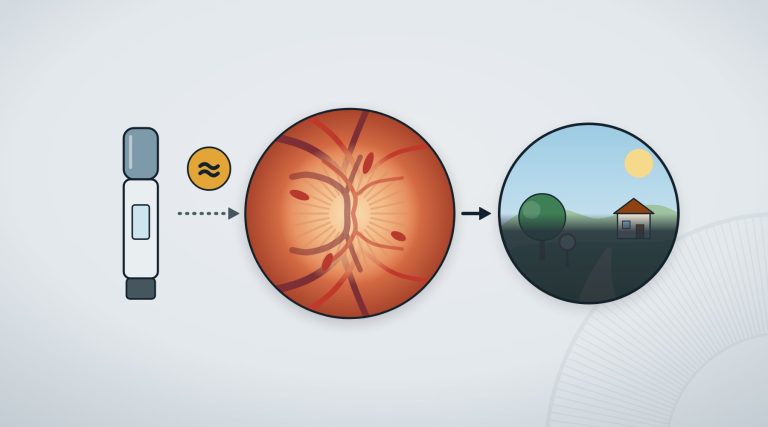
People who have it describe it almost always in the same way: like looking at the world through an old, badly tuned television. A continuous shower of minuscule, flickering dots across the whole visual field, on the sky as on the wall at home, which can last for years2.
This is visual snow, today regarded as a disorder in the way the brain processes images1. It is little known and often not recognised4, also because it is subjective: only the person who has it sees it, and even many professionals find it hard to identify8. In recent years research has taken more and more interest in it, but many questions remain open.
In brief
- Visual snow is the continuous perception of flickering dots across the whole visual field, in both eyes; when it comes with other visual disturbances it is called a syndrome1.
- How common it is is not known precisely: according to a systematic review it may affect up to 2.2% of the population3.
- It is often associated with migraine, but the most recent research regards it as a distinct disorder4,5.
- Studies of the brain indicate changes in the visual areas and in the networks that filter stimuli, which are not present in everyone, however3,8.
- There is no established treatment: studies on treatments are few and the level of evidence is low6,7.
In this article
What visual snow is: the symptoms
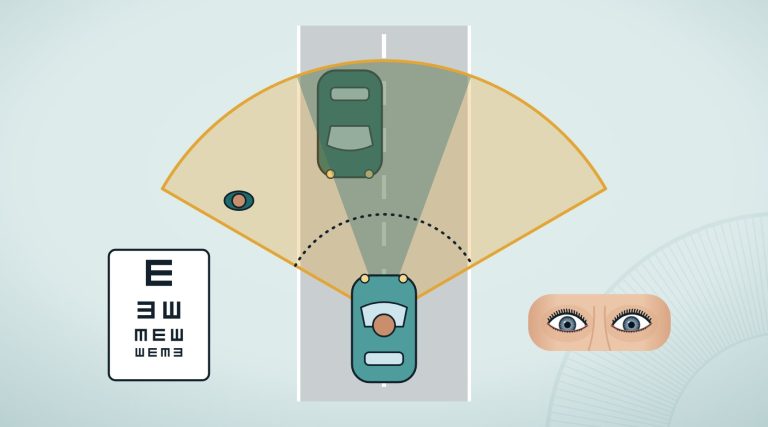
The symptom that gives the syndrome its name is countless, flickering dots across the whole visual field, similar to the ‘snow’ of an untuned television, often present all the time2. When the snow is on its own it is called visual snow; when it comes with other visual disturbances, visual snow syndrome1. The associated disturbances most often described are3,6:
- palinopsia, images that stay or repeat after you have looked away;
- a more intense perception of entoptic phenomena, that is, of what lies inside the eye itself, such as floaters;
- worse night vision;
- photophobia, that is, discomfort in light.
A 2021 systematic review also found an association with other disturbances of perception and mood and with cognitive difficulties3. Among the conditions that occur most often together with visual snow are migraine with aura and tinnitus, the whistling or buzzing in the ears7. The criteria for diagnosis, presented in a 2015 review2, now appear in the appendix to the international classification of headache disorders7.
How common it is
We do not know precisely. The 2021 review reports that up to 2.2% of the population might be affected3, while another systematic review, from 2022, found only one study devoted to how common it is7. It can appear from childhood to old age, it is more frequent in young people and it shows no differences between men and women4.
These are figures to take with caution. One of the greatest difficulties, a 2020 review points out, is that visual snow is subjective and there are no objective measures to quantify it, which are indispensable also for testing treatments1.
Visual snow and migraine: relatives, not twins
The link with migraine is close: among people with visual snow migraine is much more frequent than in the general population, and those who have both conditions have more intense symptoms4. For years visual snow was classified among the persistent visual phenomena of migraine2.
The most recent research, however, describes it as a disorder in its own right. A 2025 review, arising from a debate among specialists, re-examined clinical, imaging and electrophysiological studies5. Unlike aura, visual snow is persistent, does not change with the migraine cycle and does not respond to the medicines that work against migraine5. The similarities, such as how often the two conditions occur together, would rather be the sign of a common predisposition to increased excitability of the cerebral cortex5. We described aura in Migraine with aura.
What happens in the brain
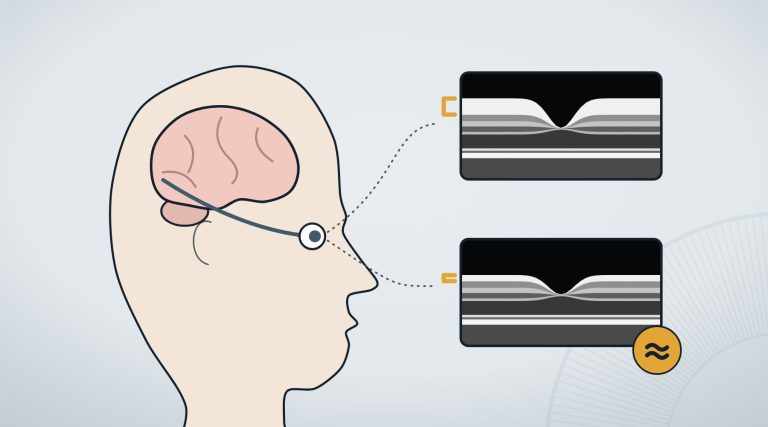
One of the first clues came from a study that measured the metabolic activity of the brain: in people with visual snow an area of the visual cortex, the lingual gyrus, consumed more energy than in controls2. For the authors it was proof that the disorder, though subjective, has a biological basis2.
Since then studies have multiplied. Electrical recordings have shown an excessive response of the visual areas, and MRI images have found differences in the fine structure and connections of several areas of the cortex and the thalamus, a relay station for sensory signals6. For this reason many researchers now regard it as a disorder of a network3,6.
The study
A systematic review of 53 studies: visual snow as a network disorder
In 2021 a group of researchers gathered all the original studies published on visual snow, excluding reviews and single cases that added no information: 53 studies in all, grouped according to the methods used. The research showed changes in the structure, functioning and metabolism of the visual areas of the brain, but also in the visual pathways that come before the cortex and in large brain networks, including those of attention. The authors’ hypothesis is that the systems that filter stimuli and decide which to prioritise work badly, and that the visual areas react too much to irrelevant external and internal signals. The limitations: not all the studies used the same definition, and the comparison groups often did not take migraine into account3.
A 2018 review brings visual snow closer to other disorders in which the brain seems to process sensations badly, such as tinnitus and a type of chronic dizziness9. But the imaging results are not found in everyone and are sometimes contradictory8, and the 2022 systematic review went so far as to write that the data are few and not solid enough to regard the syndrome as a medical entity in its own right7. The debate, in short, is open.
The treatments studied
Today there is no established treatment3,4. A retrospective study, that is, one based on clinical records, suggests a possible benefit of an antiepileptic drug in a minority of people, with low-level evidence1; according to another review, the same drug can also worsen the symptoms8. Some antidepressants have been associated with a worsening or the appearance of the visual disturbances6, and alcohol, drugs and some medicines can worsen or trigger visual snow8. A 2022 systematic review found, on treatments, only descriptions of single cases7.
Among the non-drug approaches under study are cognitive therapy based on mindfulness, coloured filters, adaptation to ‘visual noise’ and visual rehabilitation programmes6. According to a 2025 review, so far coloured filters and eye movement training seem to give the best results10. But the level of evidence remains low, and larger studies with objective measures are needed6.
When to talk to an ophthalmologist
- If, together with the dots, flashes, a shadow or a drop in vision appear, or if the disturbance affects one eye only: it is not the typical picture of visual snow, which involves the whole visual field of both eyes1. An examination is needed soon; the urgent signs are in Retinal detachment: the symptoms.
- If visual snow appeared or got worse after a medicine or the use of substances, tell your doctor8.
- If the disturbances weigh on everyday life: the ophthalmologist and neurologist can assess together the diagnosis and the possibilities available4,6.
Frequently asked questions
Is visual snow dangerous for sight?
Reviews describe it as a disorder in the way the brain processes images, not as a disease of the eye1. It can, however, weigh heavily on quality of life and last for years3.
Visual snow or floaters: what is the difference?
Floaters are shadows of small clumps in the gel that fills the eye. Visual snow, by contrast, is a continuous shower of dots across the whole visual field2. People with the syndrome, however, often notice floaters more as well3. We discuss them in Floaters.
Is visual snow linked to migraine?
The two conditions often occur together, and those who have both have more intense symptoms4. The most recent research indicates, however, that they are distinct disorders, perhaps with a common predisposition5.
Is there a cure for visual snow?
Not yet. Studies on medicines are few and the results weak, and some medicines can worsen the symptoms6,8. Coloured filters and rehabilitation approaches are under study, with evidence still at a low level6,10.
Until a few years ago, people who saw the snow had few words to describe it. Today the syndrome has a name, criteria and a series of studies that point to a basis in the brain2,3. What is missing is objective measures and larger studies, the conditions for reaching verified treatments1,6.
Sources
- Traber GL, Piccirelli M, Michels L. Visual snow syndrome: a review on diagnosis, pathophysiology, and treatment. Curr Opin Neurol. 2020;33(1):74-78. doi:10.1097/WCO.0000000000000768 · PubMed 31714263
- Schankin CJ, Goadsby PJ. Visual snow–persistent positive visual phenomenon distinct from migraine aura. Curr Pain Headache Rep. 2015;19(6):23. doi:10.1007/s11916-015-0497-9 · PubMed 26021756
- Klein A, Schankin CJ. Visual Snow Syndrome as a Network Disorder: A Systematic Review. Front Neurol. 2021;12:724072. doi:10.3389/fneur.2021.724072 · PubMed 34671311 · PMC
- Barrachina-Esteve O, Hidalgo-Torrico I, Acero C, Aranceta S, Cánovas-Vergé D, Ribera G. Visual snow syndrome and its relationship with migraine. Neurologia (Engl Ed). 2024;39(2):190-195. doi:10.1016/j.nrleng.2021.05.012 · PubMed 37442427
- Braca S, Santoro V, Sebastianelli G, Schankin CJ, Goadsby PJ, Puledda F. Visual snow vs. migraine aura: Debate summary and novel insights into the syndrome. Cephalalgia. 2025;45(9):3331024251365908. doi:10.1177/03331024251365908 · PubMed 40944402
- Aeschlimann SA, Klein A, Schankin CJ. Visual snow syndrome: recent advances in understanding the pathophysiology and potential treatment approaches. Curr Opin Neurol. 2024;37(3):283-288. doi:10.1097/WCO.0000000000001258 · PubMed 38465699 · PMC
- Sampatakakis SN, Lymperopoulos L, Mavridis T, Karagiorgis G, Papadopoulos C, Deligianni CI, et al. Visual snow: A systematic review and a case series. Cephalalgia. 2022;42(13):1409-1419. doi:10.1177/03331024221118917 · PubMed 35945691
- Rusztyn P, Stańska W, Torbus A, Maciejewicz P. Visual Snow: A Review on Pathophysiology and Treatment. J Clin Med. 2023;12(12). doi:10.3390/jcm12123868 · PubMed 37373563 · PMC
- White OB, Clough M, McKendrick AM, Fielding J. Visual Snow: Visual Misperception. J Neuroophthalmol. 2018;38(4):514-521. doi:10.1097/WNO.0000000000000702 · PubMed 30095537
- Ciuffreda KJ, Rutner D. Visual Snow Syndrome: Therapeutic Implications. J Clin Med. 2025;14(17). doi:10.3390/jcm14176070 · PubMed 40943830 · PMC
Study titles are given in their original language of publication. The superscript numbers in the text refer to these sources; citation details come from PubMed (National Library of Medicine).