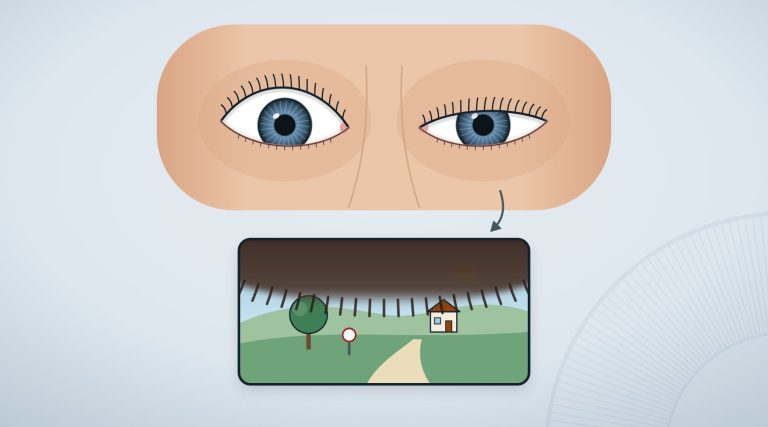
It happens mostly in front of a clear sky or a white wall: a grey strand drifts across your vision, slips away when you try to look at it and returns as soon as your gaze comes to rest. These are floaters, which ophthalmologists call myodesopsia, and almost everyone gets used to them sooner or later.
In a survey carried out through a smartphone app on 603 people, 76% said they saw floaters and a third reported that they noticeably disturbed their vision2. In the great majority of cases they are harmless. There is, however, a moment when they deserve attention, and it is not when they are there: it is when they change.
In brief
- Floaters are shadows cast on the retina by small clumps floating in the vitreous, the transparent gel that fills the eye1.
- With age the most frequent cause of new floaters is posterior vitreous detachment, a common and usually harmless change1,7.
- In a minority of cases the vitreous, as it detaches, tears the retina: among people who see an ophthalmologist for recently appeared floaters or flashes, a tear is found in about 14 people in 1003.
- Floaters that appear suddenly or increase suddenly, flashes of light, a shadow or a curtain, worsening vision: these are signs to have assessed the same day5,7.
In this article
What floaters in the eyes are
Behind the lens, the eye is filled with the vitreous, a transparent gel made largely of water and held together by collagen fibres and hyaluronic acid1. In young people it is clear and uniform. Over the years it tends to liquefy: the collagen separates from the hyaluronic acid and its fibres clump together into thicker strands, which deflect light and cast a shadow on the retina, the sensitive membrane at the back of the eye1.
What you see, then, is not an object in front of the eye but the shadow of something floating inside. This is why floaters follow the movements of your gaze and seem to dart away when you try to look at them directly6. They come in the most varied shapes: dots, worm-like strands, rings, cobwebs, in colours ranging from transparent to black6.
The ageing vitreous: posterior detachment
With age, the gel that liquefies is joined by a weaker adhesion between the vitreous and the retina. At a certain point the back part of the vitreous detaches from the retina: this is posterior vitreous detachment, the most frequent cause of floaters that appear for the first time1. The UK National Health Service (NHS) describes it as a harmless process, common in older people7.
When it happens, it can suddenly cause new floaters and flashes of light in one eye3. In most cases, over time the flashes become less frequent and the floaters become less noticeable, partly because you get used to not noticing them7.
Who sees them most
Short-sightedness is the most frequently cited factor. In the short-sighted eye, as happens with age, the collagen fibres of the vitreous tend to clump together1,6, and a 2025 review stresses that more and more young people, especially short-sighted ones, are bothered by floaters, in parallel with the spread of short-sightedness6. We also discuss this in our article on short-sightedness.
The survey of the 603 smartphone users found something similar: people who were short-sighted were about 3.5 times more likely to report moderate or severe floaters than those with normal vision, and people who were long-sighted 4.4 times; age and sex made no difference in that sample2. But it was a sample of volunteers, not a representative population.
For some people they are not a minor nuisance: reviews of recent years indicate that they can weigh on quality of life more than was thought, and that they can reduce contrast sensitivity, that is, the ability to distinguish close shades of grey1,6.
When floaters are a signal not to be ignored
As it detaches, the vitreous sometimes pulls on the retina enough to tear it. Fluid can pass through the tear, and the retina can lift: this is retinal detachment, which without treatment can lead to permanent loss of vision3,7.
A 2009 systematic review pooled 17 studies of people with recently appeared floaters or flashes, examined by an ophthalmologist: a retinal tear was present in about 14 in 1003. The symptom most closely linked to a tear was the feeling of seeing worse. Even people who at the first examination had an uncomplicated vitreous detachment were not entirely safe: about 3 people in 100 had a tear in the following six weeks, and the risk was higher in those who noticed at least ten new floaters or a drop in vision3.
The study
Floaters at the family doctor: a Dutch study
A study published in 2026 reviewed the medical records of seven general practice surgeries in the Netherlands between 2012 and 2021, looking for adults who had presented with recently appeared floaters or flashes: 1,181 people. The absolute risk of retinal detachment was 6.1% with floaters alone, 4.7% with flashes alone and 8.4% with both symptoms. Floaters that had appeared no more than 14 days earlier and especially numerous ones (ten or more, or a cloud, a haze or a curtain) were associated with a higher risk: those with many floaters and also flashes had a risk about six times greater than those with flashes only. It is a retrospective study, based on records, but it observes people where they first present, not only in specialist clinics5.
What emerges from the studies is that it matters less whether you have floaters than the way they appear: suddenly, in large numbers, together with flashes, a shadow or blurrier vision3,5,7. We describe what happens when the retina detaches in our article on retinal detachment.
What happens at the examination
When floaters are new, the key examination is looking at the back of the eye, that is, the retina4. Two details weigh heavily: the presence of blood in the vitreous makes a tear more likely, while the absence of pigment granules in the vitreous makes it less likely3.
A tear can be missed at the first examination or appear afterwards. In a 2007 study based on a case series, tears were found in 8.2% of eyes with symptomatic vitreous detachment, and 1.8% of people had a tear that was not seen at the first examination4. But in 24 of the 29 cases of late tear there were already clues at the first examination (blood in the vitreous or in the retina) or new symptoms had appeared4. According to the authors, most people with a normal first examination may not need close follow-up: those signs and changing symptoms guide the choice3,4.
If the floaters stay and disturb
Floaters often become less noticeable with time7; for a minority they remain a nuisance that weighs on reading and on mood1,6. A laser and an operation called vitrectomy have very different benefits and risks: we compare them in Eye floaters: can they be removed?.
When to talk to an ophthalmologist
- The same day: go to an emergency department (A&E) or call 112 if you see floaters or flashes for the first time, if floaters suddenly increase (a shower of dots, a cloud), if a shadow or a dark curtain appears over part of your vision, or if your vision becomes hazy5,7. They may be signs of a retinal tear or detachment: you will find all the urgent signs on our page about eye emergencies.
- Floaters that appear after eye surgery or an eye injury, or together with pain, must be assessed with the same urgency7.
- If in the weeks after a first examination the floaters increase or your vision changes, that is a reason to be seen again at once: a small proportion of tears appear later3,4.
- Floaters that have been present for some time, stable, that do not change your vision: if they bother or worry you, talk to the ophthalmologist at your next visit7.
Frequently asked questions
Are floaters in the eyes dangerous?
Usually not: in most cases they are due to changes in the vitreous linked to age or short-sightedness1,7. They become a signal to have assessed at once when they appear suddenly, increase suddenly or arrive together with flashes, a shadow or a drop in vision3,5.
Can floaters go away on their own?
They often become less noticeable with time, partly because you get used to not noticing them, and flashes tend to become less frequent7. They do not always disappear completely: for those who are greatly bothered by them there are treatments, with their risks.
I have had floaters for years: do I need to do anything?
If they are always the same, do not increase and your vision has not changed, the UK National Health Service usually regards them as not worrying7. What matters is noticing whether they change: new floaters, flashes or a shadow are a reason to be examined the same day5.
Floaters are, almost always, the sign of an eye that ages like the rest of the body. Their value as a signal lies in change: when they arrive suddenly, with flashes or a shadow, an examination within the day makes it possible to find a tear before it becomes a detachment3,7.
Sources
- Milston R, Madigan MC, Sebag J. Vitreous floaters: Etiology, diagnostics, and management. Surv Ophthalmol. 2016;61(2):211-27. doi:10.1016/j.survophthal.2015.11.008 · PubMed 26679984
- Webb BF, Webb JR, Schroeder MC, North CS. Prevalence of vitreous floaters in a community sample of smartphone users. Int J Ophthalmol. 2013;6(3):402-5. doi:10.3980/j.issn.2222-3959.2013.03.27 · PubMed 23826541 · PMC
- Hollands H, Johnson D, Brox AC, Almeida D, Simel DL, Sharma S. Acute-onset floaters and flashes: is this patient at risk for retinal detachment?. JAMA. 2009;302(20):2243-9. doi:10.1001/jama.2009.1714 · PubMed 19934426
- Coffee RE, Westfall AC, Davis GH, Mieler WF, Holz ER. Symptomatic posterior vitreous detachment and the incidence of delayed retinal breaks: case series and meta-analysis. Am J Ophthalmol. 2007;144(3):409-413. doi:10.1016/j.ajo.2007.05.002 · PubMed 17583667
- van Zon B, Spoelder M, Peters HJ, Akkermans R, Crama N, van de Laar FA. Do Vitreous Floaters Predict Retinal Detachment? Retrospective Cohort Study in Primary Care. Ann Fam Med. 2026;24(2):111-116. doi:10.1370/afm.240149 · PubMed 41876118 · PMC
- Albrecht M, Auffarth GU, Friedrich M, Kessler LJ, Khoramnia R. Vision degrading myodesopsia from vitreous floaters in the young: An important aspect of myopia. Surv Ophthalmol. 2025;70(2):265-282. doi:10.1016/j.survophthal.2024.10.001 · PubMed 39424075
- NHS. Floaters and flashes in the eyes. nhs.uk
Study titles are given in their original language of publication. The superscript numbers in the text refer to these sources; citation details come from PubMed (National Library of Medicine).