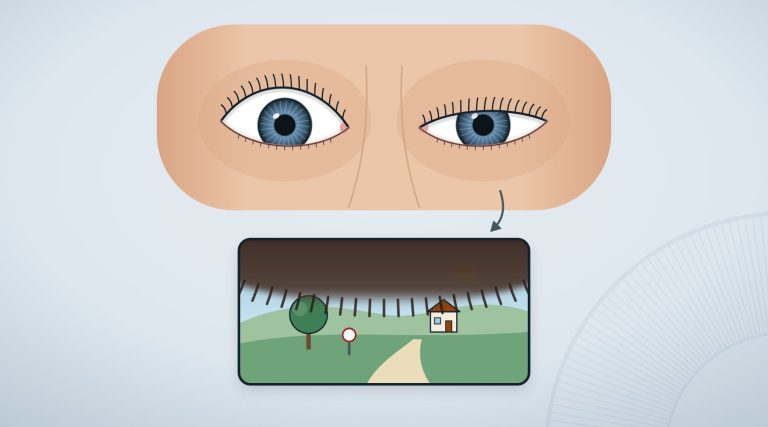
One evening, without warning, an eye turns red. It hurts, a dull ache; a headache arrives, and in the mirror the pupil of that eye looks bigger than the other. This is the typical picture of acute angle closure: the pressure inside the eye rises suddenly and, if it is not lowered quickly, it damages the optic nerve3.
It is also the most dramatic way to discover that glaucoma is not a single disease. The most common form, open-angle glaucoma, goes on for years without giving any signs1. Angle-closure glaucoma, by contrast, can stay silent for a long time8 or present as an emergency. Understanding the difference helps you to know what to ask your ophthalmologist and when a problem cannot wait for the next check-up.
In brief
- The two forms are distinguished by the state of the angle, the area through which the eye’s internal fluid drains away: clear in one, blocked by the iris in the other1,3.
- Angle-closure glaucoma is less common than open-angle glaucoma and more widespread in Asia; age, long-sightedness and East Asian ancestry favour it1,2.
- An acute attack (a suddenly red eye, pain, headache, dilated pupil) is an emergency3.
- Some drugs can trigger an attack in people with a narrow angle, often without their knowing it4.
- The most recent studies have scaled back preventive laser for people who have only narrow angles and have reassessed surgery on the lens6,8.
In this article
What the angle is, and why it makes the difference
A clear fluid, the aqueous humour, circulates inside the eye; it nourishes the structures at the front and drains away through a filter, the trabecular meshwork. This filter sits in the angle between the cornea, the transparent window at the front of the eye, and the iris, the coloured disc.
In open-angle glaucoma the access route to the filter is clear, but the fluid drains away with difficulty. In angle-closure glaucoma, by contrast, the iris comes up against the filter and obstructs it. The most common cause is so-called pupillary block in eyes that already have narrow angles, as is often the case in long-sighted people3. With age, the lens, the natural lens of the eye, grows and contributes to narrowing the angle10.
In both cases the word glaucoma indicates the same consequence: damage to the optic nerve with loss of the visual field1.
| Open angle | Angle closure | |
|---|---|---|
| What happens | The filter can be reached, but the fluid drains away poorly | The iris comes up against the filter and blocks access to it |
| How it presents | Without symptoms until the advanced stages1 | At first often without loss of vision8; sometimes with an acute attack3 |
| Main risk factors | Age, high eye pressure, family history, high short-sightedness, sub-Saharan African ancestry1 | Age, long-sightedness, East Asian ancestry1 |
| Where it is most common | Africa2 | Asia2 |
Angle-closure glaucoma: who is at risk
A meta-analysis of 50 population studies estimated that angle-closure glaucoma reaches its highest frequency in Asia, affecting 1.1% of people aged 40 to 802. In the pooled studies, there were 786 angle-closure cases among about 112,000 people examined, and 3,770 open-angle cases among about 140,000: the closed form is less common, but far from rare2.
The main risk factors are advanced age, long-sightedness (long-sighted eyes are generally shorter, with less room in the front part) and East Asian ancestry1. One review describes it as an aggressive disease that blinds millions of people worldwide10. We also discuss this in our article on long-sightedness.
An acute attack is an emergency
In acute angle closure the drainage is blocked suddenly and the pressure rises sharply. A clinical review recommends suspecting it in anyone with a red eye that has appeared suddenly, with a dilated pupil, dull pain and headache, and starting treatment to lower the pressure straight away, with urgent referral to an ophthalmologist3. The same authors point out that other conditions, including ones affecting the nervous system, can cause similar symptoms: that is why a medical assessment is needed, not a guess made at home3.
After an attack, laser in the other eye has a strong preventive effect10.
Drugs and drops that dilate the pupil
A review of cases caused by drugs lists several families that, in people with narrow angles, can trigger acute closure: adrenergic substances, including in eye drops or nasal sprays, drugs with an anticholinergic effect, including eye drops that dilate the pupil, some antidepressants and a group of drugs derived from sulfonamides, which act through a different mechanism. Most attacks involve people who did not know they had narrow angles4. None of these drugs should be stopped on your own initiative: anyone who knows they have narrow angles can mention it to every doctor who proposes a new treatment. We also discuss this in our article on medicines and the eyes.
And what about the drops used to dilate the pupil during an examination? A study in Singapore dilated the pupils of 471 people over 50 with narrow angles, almost all of Chinese ancestry, together with a drug to contain the pressure: in 3 (0.64%) acute closure occurred anyway within six hours. The authors judge the risk to be low, but present5.
Laser or lens: what the studies say
For years the answer to narrow angles was laser iridotomy, a small hole in the iris that opens an alternative route for the fluid, used as prevention even with limited evidence10. Two large trials have changed the picture.
The study
ZAP: is preventive laser worth it for everyone?
In the ZAP trial, in China, 889 people aged 50 to 70 with narrow angles in both eyes, but without glaucoma, received laser in one eye chosen at random; the other was left untreated. Over six years, angle closure developed in 19 treated eyes and in 36 untreated ones: laser almost halved the risk, but the cases were few in both groups. According to the authors, the benefit is limited and preventive laser extended to all these people is not recommended6. At 14 years, the eyes with angle closure numbered 33 among those treated and 105 among the others; acute attacks, 1 and 5. Almost half of the eyes, however, had dropped out of the study, and the treated eyes had more cataract7.
The EAGLE trial took another route: removing the lens. In 30 hospitals in five countries, 419 people aged at least 50, without cataract, with angle-closure glaucoma or with a closed angle and very high pressure (30 mmHg or more) were randomly assigned to removal of the still-clear lens or to laser with eye drops. After three years, those who had been operated on had a higher quality-of-health score and a pressure lower by 1.2 mmHg on average; irreversible loss of sight occurred in one person who had been operated on and in three treated with laser, and there were no serious adverse events8.
A 2021 Cochrane review found moderate-certainty evidence that surgery on the lens reduces deterioration of the visual field and the number of eye drops needed, compared with laser; the comparison, however, was based on a single trial, and the trials gathered were too different for an overall numerical synthesis9. It is nonetheless a surgical operation: the choice depends on the stage of the disease and on the person. The other glaucoma treatments are described in our article on eye drops, laser and surgery.
When to talk to an ophthalmologist
- If you are long-sighted, over 50 or of East Asian ancestry: ask whether the angle was assessed during your examination1.
- If you have been told you have narrow angles, remind every doctor who proposes a new drug4.
- Immediately, the same day: an eye that suddenly turns red, with pain, headache and a dilated pupil3. Call 112 or go to an emergency department (A&E); you will find the other warning signs on our page about eye emergencies.
Frequently asked questions
Is angle-closure glaucoma more serious than open-angle glaucoma?
It is less common2, but it can be more aggressive10, and an acute attack requires immediate treatment3. There are, however, treatments that in studies have lowered pressure and slowed progression8,9.
Can the drops that dilate the pupil trigger an attack?
In people with narrow angles it is possible, but rare: in a study of 471 people at risk it happened in 35. That is why the ophthalmologist assesses the angle; you will find more in our article on the back of the eye.
If I have narrow angles, do I need laser?
Not necessarily. In people with narrow angles found through screening, without other signs, the ZAP trial found a limited benefit6,7. The case of someone who has already had an attack in one eye is different10. It is a decision to take with the ophthalmologist.
Is removing the lens enough to stop angle-closure glaucoma?
Not necessarily, and the damage already done to the optic nerve remains. In the EAGLE trial, however, the operation gave a lower pressure and a better quality of health than laser8.
Open angle and angle closure have the same possible outcome, but different stories. The first has to be looked for with check-ups, because it does not make itself felt. The second can often be recognised before it causes problems, by looking at the angle; and when it appears suddenly, there is only one rule: get seen at once, without putting it off until the next day.
Sources
- Jonas JB, Aung T, Bourne RR, Bron AM, Ritch R, Panda-Jonas S. Glaucoma. Lancet. 2017;390(10108):2183-2193. doi:10.1016/S0140-6736(17)31469-1 · PubMed 28577860
- Tham YC, Li X, Wong TY, Quigley HA, Aung T, Cheng CY. Global prevalence of glaucoma and projections of glaucoma burden through 2040: a systematic review and meta-analysis. Ophthalmology. 2014;121(11):2081-90. doi:10.1016/j.ophtha.2014.05.013 · PubMed 24974815
- Flores-Sánchez BC, Tatham AJ. Acute angle closure glaucoma. Br J Hosp Med (Lond). 2019;80(12):C174-C179. doi:10.12968/hmed.2019.80.12.C174 · PubMed 31822188
- Lachkar Y, Bouassida W. Drug-induced acute angle closure glaucoma. Curr Opin Ophthalmol. 2007;18(2):129-33. doi:10.1097/ICU.0b013e32808738d5 · PubMed 17301614
- Lavanya R, Baskaran M, Kumar RS, Wong HT, Chew PT, Foster PJ, et al. Risk of acute angle closure and changes in intraocular pressure after pupillary dilation in Asian subjects with narrow angles. Ophthalmology. 2012;119(3):474-80. doi:10.1016/j.ophtha.2011.08.033 · PubMed 22118999
- He M, Jiang Y, Huang S, Chang DS, Munoz B, Aung T, et al. Laser peripheral iridotomy for the prevention of angle closure: a single-centre, randomised controlled trial. Lancet. 2019;393(10181):1609-1618. doi:10.1016/S0140-6736(18)32607-2 · PubMed 30878226
- Yuan Y, Wang W, Xiong R, Zhang J, Li C, Yang S, et al. Fourteen-Year Outcome of Angle-Closure Prevention with Laser Iridotomy in the Zhongshan Angle-Closure Prevention Study: Extended Follow-up of a Randomized Controlled Trial. Ophthalmology. 2023;130(8):786-794. doi:10.1016/j.ophtha.2023.03.024 · PubMed 37030454
- Azuara-Blanco A, Burr J, Ramsay C, Cooper D, Foster PJ, Friedman DS, et al. Effectiveness of early lens extraction for the treatment of primary angle-closure glaucoma (EAGLE): a randomised controlled trial. Lancet. 2016;388(10052):1389-1397. doi:10.1016/S0140-6736(16)30956-4 · PubMed 27707497
- Ong AY, Ng SM, Vedula SS, Friedman DS. Lens extraction for chronic angle-closure glaucoma. Cochrane Database Syst Rev. 2021;3(3):CD005555. doi:10.1002/14651858.CD005555.pub3 · PubMed 33759192 · PMC
- Tanner L, Gazzard G, Nolan WP, Foster PJ. Has the EAGLE landed for the use of clear lens extraction in angle-closure glaucoma? And how should primary angle-closure suspects be treated?. Eye (Lond). 2020;34(1):40-50. doi:10.1038/s41433-019-0634-5 · PubMed 31649349 · PMC
Study titles are given in their original language of publication. The superscript numbers in the text refer to these sources; citation details come from PubMed (National Library of Medicine).