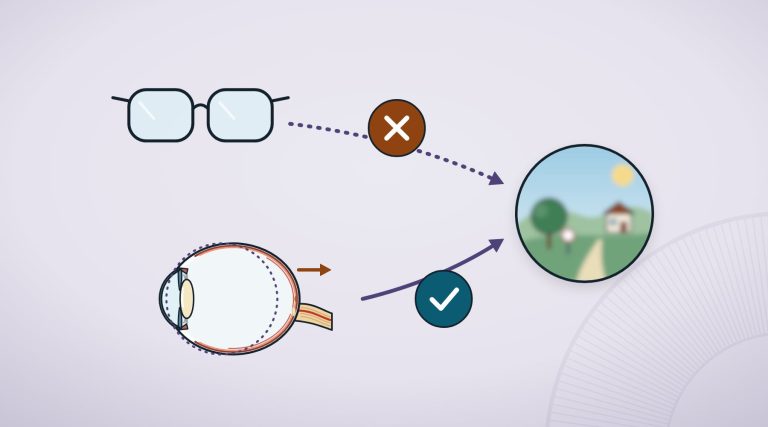
The name is misleading. ‘Long-sighted’ seems to mean ‘someone who sees far’: if the short-sighted person sees well up close, the long-sighted person should see well in the distance. This is partly true, but only as long as the eye can compensate. Long-sightedness works silently for years and makes itself felt when the reserves start to run down.
It is also a very widespread defect. In the European E3 consortium studies, which pooled almost 62,000 adults, about one in four had long-sightedness of at least one dioptre1. And at the beginning of life it is almost the rule: most children are born long-sighted2.
In brief
- In long-sightedness images would be focused behind the retina, because the eye is a little short or its lenses are not powerful enough; to see sharply, the eye has to focus with the lens, and the effort is greater up close.
- Most children are born long-sighted and the defect usually reduces as the eye grows2.
- In Europe about 25% of adults have long-sightedness of at least one dioptre1.
- The ability to focus declines with the years and by about 40 it is no longer enough for near work3: for long-sighted people, difficulties tend to be felt sooner.
- High long-sightedness in the first years of life is associated with lazy eye and squint (strabismus)7; in adults it is one of the risk factors for angle-closure glaucoma9.
In this article
What long-sightedness is: a slightly short eye
To see sharply, light has to be focused exactly on the retina, the sensitive membrane at the back of the eye. The eye’s two natural lenses, the cornea at the front and the lens inside, are calibrated to the length of the eyeball. In long-sightedness the system is too weak for that length, because the eye is shorter than needed or because the cornea and lens are not powerful enough: images would be focused behind the retina.
The eye, however, has a resource. The lens is elastic and can increase its power, like the autofocus of a camera: this is accommodation, the same one we all use to go from far to near. The long-sighted person already uses it to look into the distance, and uses even more of it to read.
In the first years of life, most of us are in this situation. A review on the role of the lens in the development of vision recalls that most children are long-sighted in the early years and that this long-sightedness is usually lost with growth. The eye goes from about 15 millimetres in premature newborns to about 24 in the young adult: a lengthening that would be worth more than 40 dioptres, but which the cornea and lens compensate for by changing their power2. Those who remain long-sighted have not fully completed this journey.
Why you see badly up close
As long as the lens is young and elastic, a long-sighted person can see well at all distances without noticing the effort. In children part of the long-sightedness can remain entirely hidden: in a retrospective study of 150 long-sighted children, the defect was ‘latent’ in 35% of cases, that is, it showed up only after drops that temporarily relax focusing (cycloplegia)5. This is why studies on children, like those cited further on, measure the dioptres after these drops8.
Continuous focusing effort, however, has a cost, which is felt above all up close. A 2026 review on children with moderate long-sightedness concludes that many of them do not see up close as well as their peers and have more difficulty with close vision, early reading and writing skills, reading and attention6.
And sometimes in the distance too: what changes with age
The ability to accommodate is not eternal. A review of the mechanisms of focusing describes a steady decline starting from late childhood; accuracy remains good until about 40, when the amplitude of accommodation falls below what is needed for normal near work3. This is presbyopia, which comes to everyone.
For long-sighted people presbyopia adds to a defect that was already using up part of the reserves: difficulties up close tend to be felt sooner, and when the reserves are no longer enough distance vision also loses sharpness. In addition, in the middle-age years refraction tends to shift towards long-sightedness even in those who had none when young2. The differences between long-sightedness and presbyopia can be found in the article on presbyopia, and the comparison with the other defects in short-sightedness, long-sightedness, astigmatism and presbyopia.
How common it is
Estimates change with the threshold and with age. A 2018 worldwide meta-analysis reports long-sightedness in 30.9% of adults and 4.6% of children, with European values lower than the world average in adults (23.1%), but with a very wide margin of uncertainty4. The E3 consortium figure, 25.2% of European adults with at least one dioptre, comes instead from 15 European population-based studies analysed together1.
Long-sightedness in children
A little long-sightedness, in the early years, is normal2. When it is high, however, it can interfere with the development of vision. A 2026 review of studies that followed children from the age of 6–24 months found that long-sightedness of at least +3.5 dioptres between 8 and 12 months was associated with a much higher risk of lazy eye (amblyopia) and of accommodative esotropia, a squint in which the eye turns towards the nose because of the focusing effort. Glasses prescribed early reduced the risk of lazy eye in some studies, with an overall effect judged to be moderate7. In the retrospective study cited above, children with long-sightedness of at least 3.5 dioptres had a 5.2 times higher risk of squint and a 3.7 times higher risk of amblyopia5.
The study
VIP-HIP: uncorrected long-sightedness and early reading skills
The VIP-HIP study compared 492 children aged 4 and 5 who had never worn glasses: 244 with long-sightedness between +3 and +6 dioptres and 248 without relevant defects. On a test of pre-reading skills, the long-sighted children scored on average 4.3 points lower; the gap was wider above 4 dioptres (6.8 points) and in children who saw worse up close (8.5 points). It is a cross-sectional study: it shows an association, it does not prove that long-sightedness is the cause or that glasses eliminate it8.
It is on precisely this point that the evidence is still incomplete: according to the 2026 review, it is not clear whether correcting moderate long-sightedness allows children to recover from difficulties with near vision, reading and attention, and more studies are needed6. We discuss this in the article on long-sightedness in children.
Long-sightedness and angle-closure glaucoma
In some people the angle through which the fluid that nourishes the front of the eye drains is narrow, and can close; long-sighted eyes are among those in which this happens10. A review published in The Lancet lists older age, long-sightedness and East Asian origin as the main risk factors for primary angle-closure glaucoma9. The acute form is an emergency: the most common cause is a blockage of the passage of the fluid in eyes with a narrow angle, like those of long-sighted people, and the pressure rises suddenly10. We discuss this in the article on open-angle and angle-closure glaucoma.
How it is corrected
Long-sightedness is corrected with converging lenses, which have the plus sign on the prescription: glasses or contact lenses add the power that is missing and spare the lens the work of compensating. Refractive surgery techniques also exist. Whether and when to correct mild long-sightedness, in an adult without symptoms or in a child, is a decision made with the ophthalmologist, taking into account age, dioptres and how one sees.
When to talk to an ophthalmologist
- A child with an eye that turns towards the nose, especially when looking up close: this is a sign to report early to the paediatrician or the ophthalmologist7.
- Difficulties up close that appear before the age of 40, or a haziness that also affects distance vision: this is useful information for the ophthalmologist.
- Immediately, the same day: a sudden red eye with a dilated pupil, dull pain and headache. They can be signs of acute angle closure, to be treated as an emergency10. Call 112 or go to an emergency department (A&E); you will find the other warning signs on our page about eye emergencies.
Frequently asked questions
Does long-sightedness get worse with age?
Often it becomes more evident. Accommodation declines from late childhood and by about 40 it is no longer enough for near vision3; moreover, in middle age refraction tends to shift towards long-sightedness2.
What is the difference between long-sightedness and presbyopia?
Long-sightedness depends mainly on the length of the eye and exists from birth; presbyopia is the age-related loss of accommodation, which affects everyone2,3. The two conditions can add up.
Do all long-sighted children need glasses?
No: a little long-sightedness is normal in the early years and tends to reduce with growth2. High long-sightedness, however, is associated with lazy eye and squint7, while for moderate long-sightedness the evidence on the benefits of glasses is still uncertain6. The decision is for the ophthalmologist.
Can long-sightedness cause glaucoma?
It does not cause it directly, but the long-sighted eye more often has a narrow angle, and this is one of the main risk factors for angle closure9,10.
Long-sightedness usually makes no noise: the lens compensates for it, as long as it can. Knowing about it helps to read the right signs in children, to put a name to the near-vision tiredness that arrives with the years and to recognise the sudden red, painful eye, when there is no time to lose.
Sources
- Williams KM, Verhoeven VJ, Cumberland P, Bertelsen G, Wolfram C, Buitendijk GH, et al. Prevalence of refractive error in Europe: the European Eye Epidemiology (E(3)) Consortium. Eur J Epidemiol. 2015;30(4):305-15. doi:10.1007/s10654-015-0010-0 · PubMed 25784363 · PMC
- Iribarren R. Crystalline lens and refractive development. Prog Retin Eye Res. 2015;47:86-106. doi:10.1016/j.preteyeres.2015.02.002 · PubMed 25683786
- Charman WN. The eye in focus: accommodation and presbyopia. Clin Exp Optom. 2008;91(3):207-25. doi:10.1111/j.1444-0938.2008.00256.x · PubMed 18336584
- Hashemi H, Fotouhi A, Yekta A, Pakzad R, Ostadimoghaddam H, Khabazkhoob M. Global and regional estimates of prevalence of refractive errors: Systematic review and meta-analysis. J Curr Ophthalmol. 2018;30(1):3-22. doi:10.1016/j.joco.2017.08.009 · PubMed 29564404 · PMC
- Jeddi Blouza A, Loukil I, Mhenni A, Khayati L, Mallouche N, Zouari B. [Management of hyperopia in children]. J Fr Ophtalmol. 2007;30(3):255-9. doi:10.1016/s0181-5512(07)89587-8 · PubMed 17417151
- Kulp MT, Ciner EB, Candy TR, Ying GS, Hall C, Quinn G, et al. Impact of uncorrected hyperopia on visual function and academic performance in preschool and school-age children. Optom Vis Sci. 2026;103(2):e70018. doi:10.1002/ovs2.70018 · PubMed 41926780 · PMC
- Steltman JS, Loudon SE, Simonsz HJ. Evidence for hypermetropia, astigmatism, and anisometropia associated with, and early glasses preventing, the development of amblyopia and accommodative esotropia. Strabismus. 2026;34(1):87-102. doi:10.1080/09273972.2025.2551059 · PubMed 40891638
- VIP-HIP Study Group, Kulp MT, Ciner E, Maguire M, Moore B, Pentimonti J, et al. Uncorrected Hyperopia and Preschool Early Literacy: Results of the Vision in Preschoolers-Hyperopia in Preschoolers (VIP-HIP) Study. Ophthalmology. 2016;123(4):681-9. doi:10.1016/j.ophtha.2015.11.023 · PubMed 26826748 · PMC
- Jonas JB, Aung T, Bourne RR, Bron AM, Ritch R, Panda-Jonas S. Glaucoma. Lancet. 2017;390(10108):2183-2193. doi:10.1016/S0140-6736(17)31469-1 · PubMed 28577860
- Flores-Sánchez BC, Tatham AJ. Acute angle closure glaucoma. Br J Hosp Med (Lond). 2019;80(12):C174-C179. doi:10.12968/hmed.2019.80.12.C174 · PubMed 31822188
Study titles are given in their original language of publication. The superscript numbers in the text refer to these sources; citation details come from PubMed (National Library of Medicine).