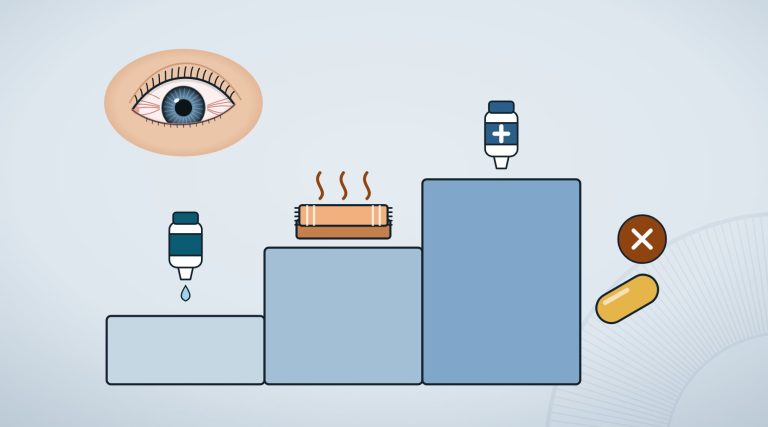
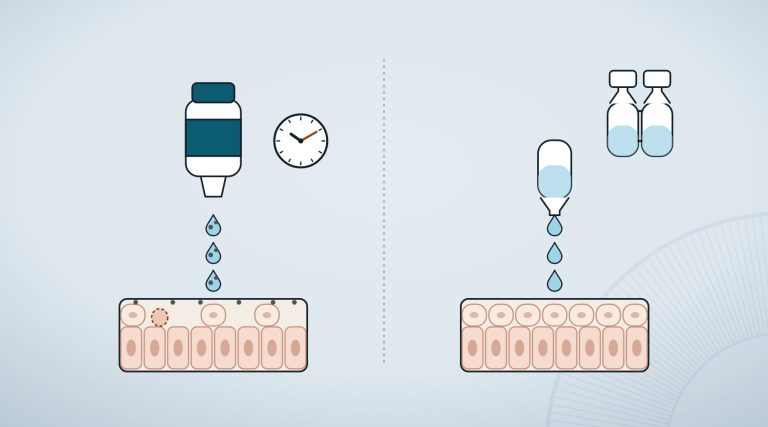
It usually makes itself felt towards evening. The eyes burn and sting, it feels as though a grain of sand has got under the eyelids; in front of the screen the lines seem less sharp and the eyes tire sooner. Many people call it tiredness, and sometimes it is. At other times it is dry eye, one of the most common eye problems9.
For a long time, dry eye was treated as a nuisance to be put up with. Today it is described as a disease in its own right, with precise criteria for recognising it: this is restated by the TFOS DEWS III report, published in 2025 by the Tear Film & Ocular Surface Society, an international scientific society, eight years after the previous one1.
In brief
- Dry eye is a disease with several causes: the tear film loses its balance, becomes unstable and too concentrated, and the surface of the eye becomes inflamed1.
- Symptoms include irritation, redness, itching, discomfort in light and vision that becomes hazy9.
- In studies the frequency ranges from 5 to 50%, depending on how it is measured; in a large Dutch study it affected 9.1% of adults3,5.
- Age, female sex, contact lenses, eye surgery, certain medicines and dry environments are among the most studied risk factors4,5.
- For the diagnosis, discomfort is not enough: a short questionnaire and at least one test showing a sign on the surface of the eye are needed1.
In this article
What dry eye is according to the TFOS DEWS reports
On the cornea, the transparent part of the eye, there is a very thin veil: the tear film. It is not just water: the TFOS DEWS III report classifies its possible deficiencies across three components, the oily part, the watery part and the mucus that keeps it attached to the surface1.
The definition updated in 2025 says that dry eye is a multifactorial disease, always accompanied by symptoms, in which the balance of the tear film or of the ocular surface is lost. Four intertwined causes are involved: unstable tears, tears that are too concentrated (ophthalmologists speak of hyperosmolarity), inflammation and damage of the surface, and alterations of the nerves that regulate its sensitivity1.
Three words count more than the others. Multifactorial: there is no single cause. Disease, and not simply a syndrome. Symptomatic: without symptoms, one does not speak of dry eye1. Already in 2017 the nerves had entered the picture for the first time as a cause, together with cases in which there are symptoms, such as pain, without obvious signs on the surface2.
Dry eye: the most common symptoms
For the TFOS reports, symptoms include both discomfort and visual disturbances2. Among those described by reviews are9:
- irritation, which many people describe as burning or as grit in the eyes;
- redness and itching;
- discomfort in light;
- vision that becomes hazy;
- mucus discharge.
These are not minor complaints. An analysis of the Dutch Lifelines study questioned 89,022 adults with two questionnaires, one on dry eye and one on vision-related quality of life. Even after taking into account age, income and 55 other diseases, people with dry eye much more often reported impaired visual quality of life, to a similar or greater extent than people with macular degeneration or glaucoma. The study is observational: it shows an association, it does not measure damage to vision7.
Two mechanisms, often together
The TFOS reports distinguish two broad mechanisms. In aqueous-deficient dry eye, the lacrimal glands produce little water; in evaporative dry eye, the tears are there but evaporate too quickly. The 2017 report made it clear that they are not two separate boxes: they are the ends of a single line, and in many people they coexist2.
The evaporative form is linked above all to the meibomian glands, a row of small glands that open on the edge of the eyelids and produce the oily part of the tears. In the evaporative forms, malfunction of these glands is the most common feature6. Blepharitis, inflammation of the edge of the eyelids, is also among the eye-related risk factors for dry eye4.
How common it is
It depends on how you look for it. The epidemiological review of the TFOS DEWS II report, which included a meta-analysis of published data, found values of 5 to 50%; the signs visible on examination are more frequent and more variable than the symptoms reported. The frequency rises with age and is higher in women, although the difference becomes clear only with the years; Asian ancestry is a fairly consistent risk factor3.
A 2024 review, with deliberately cautious estimates, calculates that between 10 and 20% of people over 40 have moderate to severe symptoms or seek medical help for this4. In Europe, an important figure comes from the same Lifelines study: among 79,866 adults aged 20 to 94, 9.1% had dry eye according to the questionnaire used by the researchers. Symptoms were particularly frequent between the ages of 20 and 30, a result that the authors consider worrying and in need of further study5.
Who is most at risk
Reviews divide the risk factors into those that cannot be changed and those that can, at least in part, be acted upon4:
- advanced age, female sex, East Asian ancestry4; the role of hormones is one of the chapters of the TFOS DEWS III report6 and we describe it in our article on dry eye in menopause;
- general diseases such as migraine, connective tissue diseases, diabetes, mental health disorders and Sjögren’s syndrome, an autoimmune disease4;
- contact lenses and eye surgery, including cataract surgery and laser correction of refractive errors, strongly associated with dry eye in the Lifelines study5; the TFOS DEWS III report includes them among the causes of iatrogenic dry eye, that is, linked to medical treatment6;
- certain medicines, including antidepressants, antihistamines and hormone replacement therapy4;
- environment and habits: dry air, prolonged use of screens, poor-quality sleep, diet and eye make-up4.
On medicines, the Lifelines study analysed the treatments of 79,606 people: taking each person’s diseases into account, the strongest links with dry eye symptoms involved medicines for ulcers and reflux (in particular proton pump inhibitors), eye drops for glaucoma and anticholinergic medicines8. These are associations: none of them, on its own, says that a treatment should be changed, and it is a matter to raise with the doctor who prescribed it.
How the diagnosis is made
The TFOS DEWS III report proposes a precise pathway. First, other conditions that can cause similar complaints are ruled out. Then it uses a six-question questionnaire, the OSDI-6: a score of 4 or more raises the suspicion of dry eye1.
The suspicion becomes a diagnosis if at least one of these signs is also present1:
- the tear film breaks up in less than 10 seconds after a blink, measured without touching the eye;
- the tears are too concentrated in at least one eye, or very different between the two eyes;
- after a coloured eye drop, small spots appear on the cornea, the conjunctiva or the edge of the eyelids, a sign that the surface is damaged.
Once the diagnosis has been made, other tests serve to understand which component weighs most: the oily part, the watery part, the mucus, the eyelids, the nerves or the inflammation. It is this distinction that guides the choice of treatments1, which we discuss in our article on remedies for dry eye.
When to talk to an ophthalmologist
- If the discomfort has lasted for weeks, comes back every day or forces you to stop while reading, driving or working.
- If you wear contact lenses, have recently had eye surgery or use medicines associated with dry eye5,8.
- If, along with dry eyes, your mouth is also always dry: it may be useful to rule out an autoimmune disease.
- Immediately, the same day: severe eye pain, a very red eye with vision that suddenly worsens, intense discomfort in light. If the situation is serious, call 112; you will find the other warning signs on our page about eye emergencies.
Frequently asked questions
Is dry eye a disease or just a nuisance?
For the international TFOS DEWS reports it is a disease in every respect, with several causes and always accompanied by symptoms1. In population studies it weighs on vision-related quality of life as much as other, better-known eye diseases7.
Do screens cause dry eye?
Prolonged use of screens is among the lifestyle factors associated with dry eye, along with dry air and poor-quality sleep4. These are mostly associations: they do not say how much each factor weighs in an individual person.
Do contact lenses cause dry eye?
Contact lens use is among the factors most strongly associated with dry eye in the Lifelines study5, and the TFOS DEWS III report lists it among the causes linked to devices and medical treatment6. If you wear lenses and have symptoms, this is information to give your ophthalmologist.
Can you have dry eye without feeling it?
The surface of the eye can show signs of distress even in people who report no complaints: in studies, signs are more frequent than symptoms3. Under the 2025 definition, however, dry eye disease is spoken of only when symptoms are present1.
Dry eye is common and has many causes, often more than one in the same person. Today, however, there are shared criteria for recognising it and understanding where it comes from1: the first step in choosing, with your ophthalmologist, what to do.
Sources
- Wolffsohn JS, Benítez-Del-Castillo JM, Loya-Garcia D, Inomata T, Iyer G, Liang L, et al. TFOS DEWS III: Diagnostic Methodology. Am J Ophthalmol. 2025;279:387-450. doi:10.1016/j.ajo.2025.05.033 · PubMed 40451408
- Craig JP, Nichols KK, Akpek EK, Caffery B, Dua HS, Joo CK, et al. TFOS DEWS II Definition and Classification Report. Ocul Surf. 2017;15(3):276-283. doi:10.1016/j.jtos.2017.05.008 · PubMed 28736335
- Stapleton F, Alves M, Bunya VY, Jalbert I, Lekhanont K, Malet F, et al. TFOS DEWS II Epidemiology Report. Ocul Surf. 2017;15(3):334-365. doi:10.1016/j.jtos.2017.05.003 · PubMed 28736337
- Britten-Jones AC, Wang MTM, Samuels I, Jennings C, Stapleton F, Craig JP. Epidemiology and Risk Factors of Dry Eye Disease: Considerations for Clinical Management. Medicina (Kaunas). 2024;60(9). doi:10.3390/medicina60091458 · PubMed 39336499 · PMC
- Vehof J, Snieder H, Jansonius N, Hammond CJ. Prevalence and risk factors of dry eye in 79,866 participants of the population-based Lifelines cohort study in the Netherlands. Ocul Surf. 2021;19:83-93. doi:10.1016/j.jtos.2020.04.005 · PubMed 32376389
- Stapleton F, Argüeso P, Asbell P, Azar D, Bosworth C, Chen W, et al. TFOS DEWS III: Digest. Am J Ophthalmol. 2025;279:451-553. doi:10.1016/j.ajo.2025.05.040 · PubMed 40472874
- Morthen MK, Magno MS, Utheim TP, Snieder H, Jansonius N, Hammond CJ, et al. The vision-related burden of dry eye. Ocul Surf. 2022;23:207-215. doi:10.1016/j.jtos.2021.10.007 · PubMed 34743866
- Wolpert LE, Snieder H, Jansonius NM, Utheim TP, Hammond CJ, Vehof J. Medication use and dry eye symptoms: A large, hypothesis-free, population-based study in the Netherlands. Ocul Surf. 2021;22:1-12. doi:10.1016/j.jtos.2021.06.009 · PubMed 34171471
- Marshall LL, Roach JM. Treatment of Dry Eye Disease. Consult Pharm. 2016;31(2):96-106. doi:10.4140/TCP.n.2016.96 · PubMed 26842687
Study titles are given in their original language of publication. The superscript numbers in the text refer to these sources; citation details come from PubMed (National Library of Medicine).