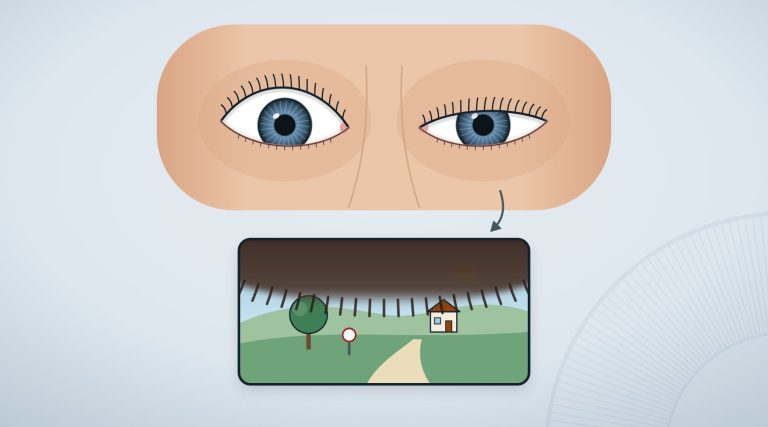
It starts with an irritation on the edge of the eyelid, like a grain of sand. The next day there is a small red, tense swelling, which hurts when you blink; sometimes a yellow dot appears on top. It is a stye, and the question that follows is always the same: how do you treat it?
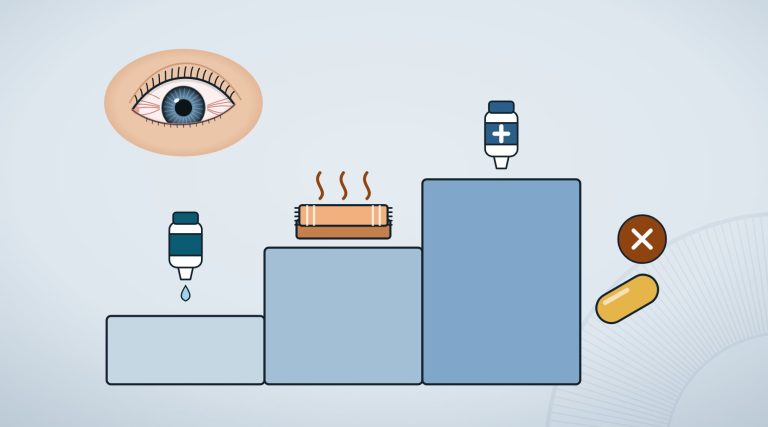
The most honest answer is surprising. A Cochrane review, updated several times up to 2017, looked for controlled studies of non-surgical treatments of internal stye, warm compresses included, and did not find a single one3. Much of what is done for a stye is based on clinical experience rather than evidence. That does not mean it is wrong: it means we know less about it than is believed.
In brief
- A stye is an acute infection, with pus, of a small gland of the eyelid or of an eyelash follicle1.
- Reviews describe it as a condition that in most cases resolves on its own with time2.
- On treatments the evidence is scarce: a Cochrane review found no controlled studies of non-surgical therapies for internal stye3.
- In a study of 2,712 people, adding an antibiotic to basic measures was not associated with more frequent resolution4.
- In rare cases the infection spreads to the tissues around the eye: among adults admitted to hospital for these infections, stye was one of the most common starting points7.
In this article
What a stye is
The edge of the eyelids hosts many small glands: some, at the base of the lashes, produce sebum or sweat; others, deeper and called meibomian glands, produce the oily part of the tears. A stye is an acute, localised swelling, full of pus, that arises when the follicle of an eyelash or one of these glands becomes blocked and infected1.
We speak of an external stye when it forms on the edge of the eyelid, at the base of a lash, and of an internal stye when it involves the deeper glands and bulges towards the inside of the eyelid. A review for family doctors summarises it thus: a well-defined lump on the edge of the eyelid is often a stye, while a lump in the middle of the eyelid is more often a chalazion8.
Stye and chalazion are the most common inflammatory swellings of the eyelid, and can appear in people with poor function of the meibomian glands or with chronic blepharitis, inflammation of the edge of the eyelid2. In a survey of 80 Korean ophthalmologists specialising in eyelid surgery, redness, swelling and pain were the signs considered most useful for distinguishing a stye from a chalazion5: we describe the differences in our article chalazion or stye?
How long it lasts and how it develops
In the sources we have examined there is no study that has precisely measured how long a stye lasts, on average. A German review from 2022 describes a typical course: the diagnosis is almost always made by examination alone, and most of these swellings resolve spontaneously with time; in some cases, however, a small procedure becomes unavoidable2.
Clinical practice gives an idea of the timescale. In the Korean survey, most surgeons continued non-surgical treatment for 5–14 days before considering a small incision to drain the stye5. It is a shared habit, not an experimental result, but it gives the idea: we are talking about days or a few weeks, not months.
Stye: how to treat it according to the studies
The study
The review that found no studies
Cochrane published its review of non-surgical treatments of internal stye in 2010 and updated it in 2013 and 2017. It looked for randomised or quasi-randomised trials that compared warm compresses, cleaning of the eyelid margin, antibiotics or cortisone with simple observation, a placebo or another treatment. In all three updates the result was the same: no study with these characteristics. The few publications on acute internal stye were recommendations, case series or observational studies, all more than twenty years old. The authors’ conclusion: there is no evidence either for or against the effectiveness of these treatments3.
Warm compresses. They are the measure most associated with stye and appear as part of the ‘conventional’ treatment even in studies of other therapies6. No controlled study, however, has evaluated them on their own3. They are a reasonable practice of long tradition, but their effectiveness has not been measured.
Antibiotics. A University of California study reviewed the records of 2,712 people treated for a stye or a chalazion between 2012 and 2018. More than a third had received an antibiotic, but adding it to basic measures was not associated with a higher probability of resolution, either for stye or for chalazion4. It is a retrospective study, which looks at the past and cannot rule out differences between those who received the antibiotic and those who did not. And yet, in the Korean survey, 74% of surgeons preferred a topical antibiotic for stye5: an example of the distance between habits and evidence.
Acupuncture. Another Cochrane review, from 2017, pooled 6 randomised trials with 531 participants, all conducted in China. The trials were at high or unclear risk of bias, follow-up lasted seven days at most and the certainty of the evidence was judged low or very low6. They are not enough to draw conclusions.
Why it is better not to squeeze it
Squeezing a stye like a spot is an instinctive gesture. No study has tested it, so we do not know precisely how risky it is. We do know, however, that a stye is a real infection1 and that, in a small proportion of cases, the infection can spread.
A study of 224 adults admitted to a hospital in Taiwan between 2000 and 2019 for cellulitis of the tissues around the eye, an infection of the eyelid and neighbouring tissues, looked for the starting point: after infection of the tear ducts, the second most frequent was precisely a stye, present in between 15.5% and 24.8% of cases depending on the period7. The figure does not say that squeezing made the infection worse; it says that a stye, in rare cases, does not remain a small problem. When a stye needs draining, the doctor does it with a small incision5. We check the other common beliefs in our article is a stye contagious?
When a stye comes back
Sometimes a stye returns. Reviews link this to chronic eyelid disorders, such as poor function of the meibomian glands and blepharitis2. A US study reconstructed the history of 201 people who had had a stye as children: as adults, 5.5% had rosacea, an inflammatory skin disease of the face, against 1.5% of those who had not had one9. It is an observed association, not proof of cause. A swelling that keeps coming back in the same place or has an unusual appearance deserves a check: in these cases reviews recommend ruling out other causes with a biopsy2.
When to talk to an ophthalmologist
- Immediately, the same day: swelling and redness spreading to the whole eyelid, pain when you move the eye, double vision or worsening vision. They may be signs of an infection that is spreading, to be recognised quickly7,8. Call 112 or go to an emergency department (A&E); you will find the other warning signs on our page about eye emergencies.
- If the stye does not improve after one or two weeks5.
- If it comes back often, always in the same place, or looks different from usual2.
Frequently asked questions
How long does a stye last?
There are no studies that have measured it precisely. Reviews describe a condition that in most cases resolves on its own2, and in practice surgeons usually wait 5 to 14 days before considering a small incision5.
Do warm compresses work?
We do not know for certain. They are part of the usual treatment6, but a Cochrane review found no controlled studies that measured their effectiveness3.
Is an antibiotic ointment needed for a stye?
In a study of 2,712 people, adding an antibiotic to basic measures was not associated with more frequent resolution4. It is a retrospective study, so not definitive: the choice, case by case, is up to the doctor.
Is a stye contagious?
No study has measured person-to-person contagion. A stye arises from infection of a gland or a follicle in one’s own eyelid1. We discuss this in our article devoted to common beliefs about the stye.
A stye is one of those complaints that almost everyone knows and that research has studied little. Reviews indicate that it usually resolves on its own2; for the rest, ‘we do not know’ is the most honest answer on many of the treatments in use. The firm point concerns the signs of an infection that is spreading: those must be recognised and taken to the doctor at once.
Sources
- Kim ES, Afshin EE, Elahi E. The lowly chalazion. Surv Ophthalmol. 2023;68(4):784-793. doi:10.1016/j.survophthal.2022.11.002 · PubMed 36395826
- Loth C, Miller CV, Haritoglou C, Messmer ESBM. [Hordeolum and chalazion : (Differential) diagnosis and treatment]. Ophthalmologe. 2022;119(1):97-108. doi:10.1007/s00347-021-01436-y · PubMed 34379160
- Lindsley K, Nichols JJ, Dickersin K. Non-surgical interventions for acute internal hordeolum. Cochrane Database Syst Rev. 2017;1(1):CD007742. doi:10.1002/14651858.CD007742.pub4 · PubMed 28068454 · PMC
- Alsoudi AF, Ton L, Ashraf DC, Idowu OO, Kong AW, Wang L, et al. Efficacy of Care and Antibiotic Use for Chalazia and Hordeola. Eye Contact Lens. 2022;48(4):162-168. doi:10.1097/ICL.0000000000000859 · PubMed 35296627 · PMC
- Shin HJ, Yoon JS, Choung H, Lew H. Management Practice for Hordeolum and Chalazion: A Survey of the Korean Society of Ophthalmic Plastic and Reconstructive Surgery (KSOPRS) Members. Korean J Ophthalmol. 2025;39(3):222-240. doi:10.3341/kjo.2025.0024 · PubMed 40267992 · PMC
- Cheng K, Law A, Guo M, Wieland LS, Shen X, Lao L. Acupuncture for acute hordeolum. Cochrane Database Syst Rev. 2017;2(2):CD011075. doi:10.1002/14651858.CD011075.pub2 · PubMed 28181687 · PMC
- Shih EJ, Chen JK, Tsai PJ, Bee YS. Differences in characteristics, aetiologies, isolated pathogens, and the efficacy of antibiotics in adult patients with preseptal cellulitis and orbital cellulitis between 2000-2009 and 2010-2019. Br J Ophthalmol. 2023;107(3):331-336. doi:10.1136/bjophthalmol-2021-318986 · PubMed 34607790
- Carlisle RT, Digiovanni J. Differential Diagnosis of the Swollen Red Eyelid. Am Fam Physician. 2015;92(2):106-12. PubMed 26176369
- Bamford JT, Gessert CE, Renier CM, Jackson MM, Laabs SB, Dahl MV, et al. Childhood stye and adult rosacea. J Am Acad Dermatol. 2006;55(6):951-5. doi:10.1016/j.jaad.2006.03.023 · PubMed 17097390
Study titles are given in their original language of publication. The superscript numbers in the text refer to these sources; citation details come from PubMed (National Library of Medicine).