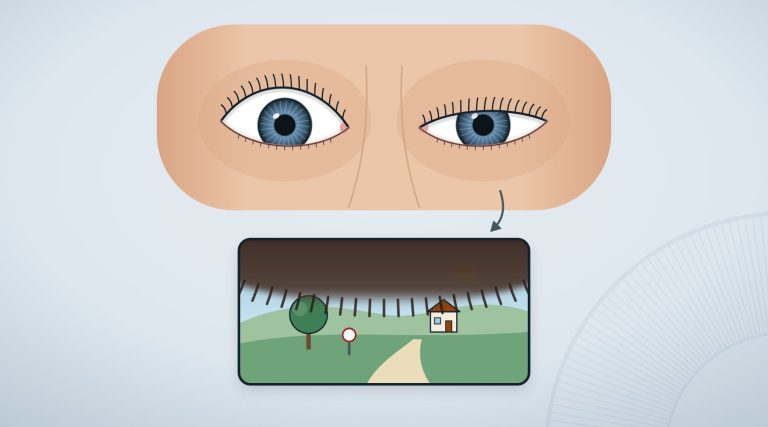
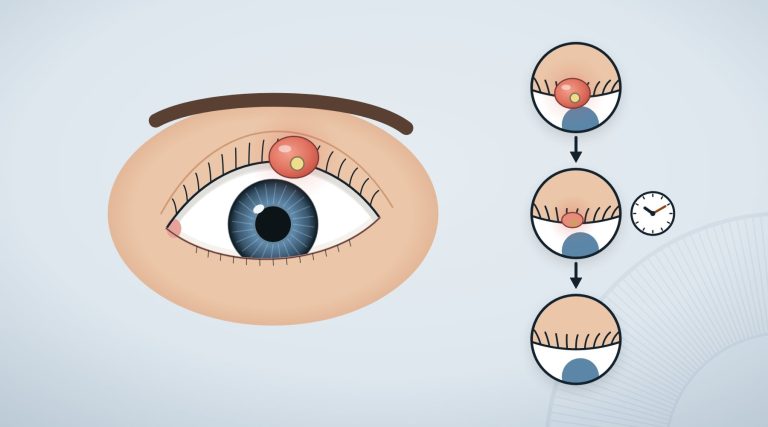
A lump on the eyelid, and a question that many people type into a search engine: chalazion or stye? The two look alike, arise from the same small glands and are easily confused. But they have different histories. A stye is an acute infection, with pus; a chalazion is a chronic inflammation, without infection, which can last for weeks or months1,4.
The scientific evidence is also different. On treatments for stye, controlled studies almost do not exist, as we explain in our article on stye. On chalazion there are some randomised trials, mainly on the two therapies with which the ophthalmologist intervenes: cortisone injection and small incision8.
In brief
- A stye is an acute infection with pus; a chalazion is a chronic, non-infectious inflammation caused by blockage of a sebaceous gland of the eyelid1.
- A well-defined lump on the edge of the eyelid is often a stye; a lump in the middle of the eyelid is more often a chalazion2.
- In a randomised trial of warm compresses, after 4–6 weeks the chalazion had disappeared completely in fewer than one case in five; older chalazia responded less4.
- Cortisone injection and small incision both work; at the first attempt the incision succeeded more often, in 78% of cases against 60%6.
- A chalazion that comes back or has an unusual appearance should be checked: in rare cases an eyelid tumour presents with the same appearance3,9.
In this article
Chalazion or stye: what distinguishes them
The edge of the eyelids contains many small glands that produce oily substances; some, the meibomian glands, are hidden in the thickness of the eyelid. A 2023 review describes the difference thus1:
- the chalazion is a small cyst of chronic inflammation that forms when one of these glands becomes blocked: the retained oil provokes a reaction of the surrounding tissues. If the gland is deep, the chalazion is in the thickness of the eyelid; if it is a gland near the lashes, it is more superficial;
- the stye is an acute, localised swelling, with pus, linked to blockage and infection of an eyelash follicle or neighbouring glands.
The same review notes that in the literature chalazion, stye and blepharitis, inflammation of the edge of the eyelids, are often described as stages of one and the same path, and that chalazion, despite being one of the most common eyelid disorders at every age, is little studied1.
| Stye | Chalazion | |
|---|---|---|
| What it is | acute infection, with pus1 | chronic inflammation, non-infectious1 |
| Where it is usually found | on the edge of the eyelid2 | in the middle of the eyelid2 |
| Duration | usually resolves on its own with time3 | often weeks or months4 |
How long a chalazion lasts
A 2022 German review notes that most styes and chalazia resolve spontaneously with time, although in some cases an intervention is unavoidable3. When the chalazion resists, however, it can be stubborn.
The study
Warm compresses, with or without eye drops
A randomised study carried out in four centres in the United States and Canada randomly assigned 149 people with chalazion to three treatments, to be followed for 4–6 weeks: warm compresses alone; warm compresses plus an antibiotic eye drop and ointment; warm compresses plus an antibiotic combined with a corticosteroid. The chalazion disappeared completely in 18% of cases, with similar percentages in the three groups: 21% with compresses alone. In all groups the lumps shrank on average by between 1.2 and 1.7 millimetres. The chalazia that disappeared had been present for less time before treatment, on average 1.5 months against 2.2. The authors suggest that, for chalazia present for more than two months, one may consider moving straight to injection or incision4.
The message is twofold. Adding antibiotic or corticosteroid eye drops to the compresses made no difference. And compresses alone, in a month or a little more, made the chalazion disappear completely in only one case in five4. A 2025 review of 39 studies notes that research on conservative therapies is scarce, while most concerns injections and surgery8.
Cortisone injection or small incision: what the trials say
When the chalazion does not go away, the ophthalmologist can propose two routes: an injection of cortisone into the lump, or a small incision under local anaesthetic to drain it, called incision and curettage.
A randomised study from 2011 compared the two techniques in 94 people with a chalazion that had not improved with conservative treatment. The lump disappeared in 79% of those who had been operated on and in 81% of those who had received the injection. With the injection resolution came on average in five days, and almost everyone had needed only one. In neither group were there complications such as skin lightening, raised eye pressure or loss of vision; in 6 people out of 52, small deposits of the medicine remained, which disappeared on their own5.
A 2016 meta-analysis pooled 8 randomised trials published between 1984 and 2013. At the first attempt incision succeeded in 78% of the 264 patients, injection in 60% of the 288 patients. With one or two attempts the percentages rose to 87% and 73%, and the gap narrowed. Complications did not differ between the two techniques6. From one study to another, however, the success of injection varied enormously, from 9% to 87%: a sign of how much the type of chalazion, the technique and the way of measuring the result matter.
A Pakistani study of 141 people found, after two weeks, a success of 79% with incision and 62% with injection, rising to 89% and 80% after a second attempt. The authors note that skin lightening at the injection site was relatively frequent in people with dark skin7. Another problem complicates comparisons: a 2025 review found that the very definition of ‘resolved chalazion’ varied greatly from one study to another8. The choice between the two routes is made with the ophthalmologist; the authors of the 2011 study propose injection above all when the diagnosis is clear and no biopsy is needed5.
When a chalazion that comes back should be checked
Reviews indicate that, in cases that do not go away, that recur or that have an unusual appearance, a different cause should be ruled out, with removal of the lump and examination under the microscope3. The reason is an uncommon tumour, sebaceous carcinoma of the eyelid, which can resemble a chalazion. In a series of 60 people with this tumour, the median age was 72 years, 73% were women and in 75% of cases the tumour was on the upper eyelid; in one case in five the first diagnosis made elsewhere had been precisely ‘chalazion’9.
Not all recurrences, of course, are suspicious. In a study of 68 adults with chalazion, Demodex infestation, a tiny mite that lives at the base of the lashes, was present in 50% of those with recurrent chalazia and in 18.5% of those with a first chalazion10. It is a small study, which shows an association and not a cause. More generally, reviews link styes and chalazia to chronic disorders of the eyelid margin3, which we discuss in our article on blepharitis.
When to talk to an ophthalmologist
- A lump that does not shrink after a few weeks of compresses, or that has been present for more than two months4.
- A chalazion that always comes back in the same place or has a different appearance from usual3.
- An eyelid lump that does not behave like a typical chalazion, especially in older people9.
- Immediately, the same day: swelling and redness spreading to the whole eyelid, pain when you move the eye, worsening vision2. Call 112 or go to an emergency department (A&E); you will find the other warning signs on our page about eye emergencies.
Frequently asked questions
How can you tell whether it is a chalazion or a stye?
A stye is an acute infection, usually on the edge of the eyelid; a chalazion is a lump of chronic inflammation, more often in the middle of the eyelid, that lasts longer1,2. The distinction is made by the doctor on examination.
Does a chalazion go away on its own?
Often it does, with time3. But in a randomised trial, after 4–6 weeks of warm compresses the chalazion had disappeared completely in only 21% of cases, and older chalazia responded less4.
Is cortisone injection into a chalazion safe?
In randomised trials it did not cause more complications than incision6. In one study there were no significant complications5; in another, carried out on people with dark skin, skin lightening at the injection site was relatively frequent7.
Can a chalazion turn into a tumour?
The studies describe a different problem: not transformation, but mistaken identity. An uncommon tumour, sebaceous carcinoma, can resemble a chalazion, and in one case series one in five had been mistaken for a chalazion at the first visit9. For this reason a chalazion that comes back or has an unusual appearance should be checked3.
Chalazion and stye are close relatives but not twins: one is an infection that usually resolves quickly, the other an inflammation that can last. On chalazion the studies say that compresses help less than you might think and that, when needed, injection and incision both work. And they recall a simple rule: a lump that does not behave as it should deserves a closer look.
Sources
- Kim ES, Afshin EE, Elahi E. The lowly chalazion. Surv Ophthalmol. 2023;68(4):784-793. doi:10.1016/j.survophthal.2022.11.002 · PubMed 36395826
- Carlisle RT, Digiovanni J. Differential Diagnosis of the Swollen Red Eyelid. Am Fam Physician. 2015;92(2):106-12. PubMed 26176369
- Loth C, Miller CV, Haritoglou C, Messmer ESBM. [Hordeolum and chalazion : (Differential) diagnosis and treatment]. Ophthalmologe. 2022;119(1):97-108. doi:10.1007/s00347-021-01436-y · PubMed 34379160
- Wu AY, Gervasio KA, Gergoudis KN, Wei C, Oestreicher JH, Harvey JT. Conservative therapy for chalazia: is it really effective?. Acta Ophthalmol. 2018;96(4):e503-e509. doi:10.1111/aos.13675 · PubMed 29338124 · PMC
- Ben Simon GJ, Rosen N, Rosner M, Spierer A. Intralesional triamcinolone acetonide injection versus incision and curettage for primary chalazia: a prospective, randomized study. Am J Ophthalmol. 2011;151(4):714-718.e1. doi:10.1016/j.ajo.2010.10.026 · PubMed 21257145
- Aycinena AR, Achiron A, Paul M, Burgansky-Eliash Z. Incision and Curettage Versus Steroid Injection for the Treatment of Chalazia: A Meta-Analysis. Ophthalmic Plast Reconstr Surg. 2016;32(3):220-4. doi:10.1097/IOP.0000000000000483 · PubMed 26035035
- Ahmad S, Baig MA, Khan MA, Khan IU, Janjua TA. Intralesional corticosteroid injection vs surgical treatment of chalazia in pigmented patients. J Coll Physicians Surg Pak. 2006;16(1):42-4. PubMed 16441988
- Park JK, Vyas C, Dagi Glass LR. Chalazia: A Scoping Review to Identify the Evidence Behind Treatments. Ophthalmic Plast Reconstr Surg. 2025;41(2):134-142. doi:10.1097/IOP.0000000000002840 · PubMed 39656051
- Shields JA, Demirci H, Marr BP, Eagle RC, Shields CL. Sebaceous carcinoma of the eyelids: personal experience with 60 cases. Ophthalmology. 2004;111(12):2151-7. doi:10.1016/j.ophtha.2004.07.031 · PubMed 15582067
- Diener-Kudisch S, Ramírez-Barajas L, Perezpeña-Diazconti JM, Nava-Castañeda Á. Correlation between Demodex species in primary and recurrent chalazia. Arch Soc Esp Oftalmol (Engl Ed). 2024;99(2):49-55. doi:10.1016/j.oftale.2023.11.009 · PubMed 38008381
Study titles are given in their original language of publication. The superscript numbers in the text refer to these sources; citation details come from PubMed (National Library of Medicine).