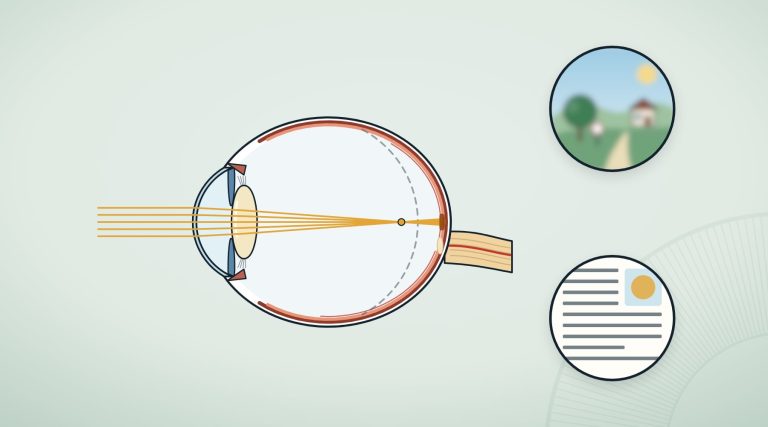
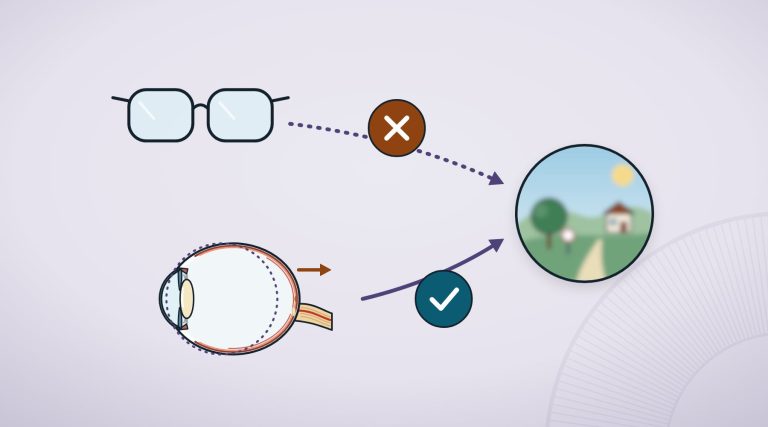
In the second year of primary school he could read the board from the last desk. In the fourth he starts to squint, and the teacher moves him to the front row. It is a story many parents know: myopia in children usually appears during the school years, when the eye lengthens a little more than it should.
Today this story concerns many more children than a generation ago. A 2025 meta-analysis, which brought together 276 studies with more than 5.4 million children and teenagers in 50 countries, estimates that the share of myopic children rose from about 24% in 1990 to about 36% in 20231. Why does it happen, and what can be said with the evidence in hand about the outdoors, books and screens?
In brief
- Worldwide about one child or teenager in three is myopic, and the share has grown over the last thirty years1; in Europe the estimates are lower, but rise sharply in adolescence2.
- The protective factor with the most solid evidence is time outdoors: in randomised trials in schools it reduced new cases of myopia, although only slightly5,6.
- More study is linked to more myopia, and for years of education the link is considered causal; the one with near work is weaker4,9.
- On screens, meta-analyses find an association that grows with the hours, but these are observational studies4,10.
- Family history matters too: children of myopic parents become myopic more often3.
In this article
Myopia in children: how common it is
The 2025 meta-analysis found higher percentages in East Asia, in cities, among girls and above all among adolescents, in whom myopia affected 47%1. If the trend continues, the authors project that in 2050 about 40% of children and teenagers will be myopic, over 740 million people1.
In Europe the picture is different. A 2025 meta-analysis of 22 studies in 14 European countries, with over 128,000 people, considered separately the studies in which vision had been measured after drops that relax the focusing muscle for a few hours (cycloplegia). In these studies myopia affected 5.5% of children aged 6 to 11 and 25.2% of those aged 12 to 172. Without the drops the values were higher, 31.2% against 18.9% overall: a technical detail that weighs heavily on the figures you see quoted2.
In Europe, in short, myopia arises mainly between the end of primary school and lower secondary school; why the dioptres then keep rising into adolescence we explain in the article on what myopia is.
Why it appears: family, study, environment
A 2023 review of studies that followed groups of children over time found that children of myopic parents develop myopia more often, and that girls have a slightly higher risk, about 1.3 times that of boys3. The same authors warn, however, that the quality of the evidence on individual factors is moderate to very low3.
Genes, on the other hand, do not change in a generation: to explain such a rapid rise we also have to look at how children grow up. An International Myopia Institute review lined up the evidence with a strict criterion, asking not only whether a factor is associated with myopia, but whether there is evidence that it causes it4:
- years of education: the causal link was confirmed by Mendelian randomisation, a method that uses genetic variants as a sort of natural experiment;
- time outdoors: its protective effect on the onset of myopia was confirmed by randomised trials;
- near work, that is, reading, writing, looking at things up close: associations generally weak and inconsistent, although supported by a meta-analysis;
- screens: weak and contradictory evidence.
Time outdoors and myopia: the school studies
Time outdoors has been tested by randomly assigning whole schools to programmes that take children outside for longer.
The study
Shanghai: 6,295 children, 24 schools, two years
The study randomly divided 24 primary schools in Shanghai into three groups: two with programmes to increase outdoor time and one control group. The children were aged between 6 and 9; outdoor time and light intensity were measured with instruments. Over two years 24.9% of the children in the control schools became myopic, against 20.6% and 23.8% in the two intervention groups; taking into account the differences between the groups, the reduction was 16% and 11%. The benefit was seen mainly in children who were not yet myopic. The main limitation: the children in the intervention groups spent about twenty minutes more a day outside than those in the control group, a time the authors themselves judge insufficient6.
In Taiwan a study of 693 first-year primary-school children in 16 schools found that, in the schools with the outdoor programme, myopia increased less: 0.35 dioptres against 0.477. According to the authors strong sunshine may not be necessary: even staying outside longer in less intense light, under trees or in an outdoor corridor, is an option to consider7.
Putting together five randomised trials with 10,733 primary-school children, a 2024 Cochrane review found that after two years about 23 children in 100 had become myopic in the groups with more outdoor time and about 27 in 100 in the comparison groups, with moderate-certainty evidence5. It is a real but modest effect, and the differences in dioptres were small5.
One point remains open: does time outdoors also slow a myopia that has already appeared? A 2017 meta-analysis found no link with the speed of worsening in children who were already myopic8; the Taiwan study, however, saw a benefit in them too7.
Near work and screens: a more uncertain link
A meta-analysis of 27 studies and over 25,000 children aged 6 to 18 found that more time spent reading, writing and doing close-up activities is associated with a slightly higher probability of myopia, about 14% more9: a modest association.
On screens the numbers are more striking. A 2025 meta-analysis of 45 studies and over 335,000 participants, with a mean age of 9, found that each additional hour a day in front of a screen is accompanied by a probability of myopia about one fifth higher; the curve rose mainly between one and four hours a day, and then more slowly10. But these are observational studies: they show that the two things go together, not that one causes the other; a child who spends many hours in front of a tablet, for example, might spend fewer outdoors. How to read these data we describe in the article on children and screens.
Why age matters
In the European data, going from the 6–11 group to the 12–17 group, the share of myopic people becomes almost five times higher2. A myopia that appears early has more years to grow before stabilising, and for this reason research looks at two moments. The first is before myopia appears: here time outdoors is the intervention with the best evidence4,5. The second is the years after diagnosis, when treatments to slow the lengthening of the eye are studied: low-dose atropine eye drops and myopia control lenses. These are choices to be assessed with the ophthalmologist, case by case.
When to talk to an ophthalmologist
- If the child squints to look into the distance, gets very close to the television or struggles to read the board.
- If one or both parents are myopic: it is useful information to mention at check-ups3.
- If an already diagnosed myopia seems to be worsening quickly, with lens changes close together.
- Promptly, without waiting for the scheduled check-up: a loss of vision in one eye only, an eye that turns or a white reflection in the pupil in photographs, which are not typical signs of myopia.
Frequently asked questions
At what age does myopia usually appear in children?
Usually during the school years. In the most rigorous European studies 5.5% of children aged 6 to 11 and 25.2% of those aged 12 to 17 were myopic2.
How much time outdoors is needed against myopia?
The studies have not identified a threshold valid for everyone. In the Shanghai study the risk fell by 15–24% with 120–150 minutes a day outdoors in full light6; in the Taiwan one even less intense light seemed useful, as long as the time outside was long7. In school programmes the overall effect was modest5.
Do screens cause myopia?
Meta-analyses find an association between hours of screen use and myopia10, but the studies are observational and an International Myopia Institute review judges the evidence weak and contradictory4. Whether screens, in themselves, cause it remains to be shown.
If the parents are myopic, will the child become myopic?
Not necessarily, but the risk is higher: in the reviews children of myopic parents develop myopia more often3. The rapid rise in recent decades indicates, however, that environment and habits matter too1,4.
Myopia in children is not a fault to be shared out between parents, school and tablets: in the growth of the eye, what counts is genes, years on books and daylight4. The factor with the clearest evidence is also the simplest, time spent outside, which in schools has reduced new cases slightly, but measurably5.
Sources
- Liang J, Pu Y, Chen J, Liu M, Ouyang B, Jin Z, et al. Global prevalence, trend and projection of myopia in children and adolescents from 1990 to 2050: a comprehensive systematic review and meta-analysis. Br J Ophthalmol. 2025;109(3):362-371. doi:10.1136/bjo-2024-325427 · PubMed 39317432
- Moreira-Rosário A, Lanca C, Grzybowski A. Prevalence of myopia in Europe: a systematic review and meta-analysis of data from 14 countries. Lancet Reg Health Eur. 2025;54:101319. doi:10.1016/j.lanepe.2025.101319 · PubMed 40672053 · PMC
- Yu M, Hu Y, Han M, Song J, Wu Z, Xu Z, et al. Global risk factor analysis of myopia onset in children: A systematic review and meta-analysis. PLoS One. 2023;18(9):e0291470. doi:10.1371/journal.pone.0291470 · PubMed 37729320 · PMC
- Morgan IG, Wu PC, Ostrin LA, Tideman JWL, Yam JC, Lan W, et al. IMI Risk Factors for Myopia. Invest Ophthalmol Vis Sci. 2021;62(5):3. doi:10.1167/iovs.62.5.3 · PubMed 33909035 · PMC
- Kido A, Miyake M, Watanabe N. Interventions to increase time spent outdoors for preventing incidence and progression of myopia in children. Cochrane Database Syst Rev. 2024;6(6):CD013549. doi:10.1002/14651858.CD013549.pub2 · PubMed 38864362 · PMC
- He X, Sankaridurg P, Wang J, Chen J, Naduvilath T, He M, et al. Time Outdoors in Reducing Myopia: A School-Based Cluster Randomized Trial with Objective Monitoring of Outdoor Time and Light Intensity. Ophthalmology. 2022;129(11):1245-1254. doi:10.1016/j.ophtha.2022.06.024 · PubMed 35779695
- Wu PC, Chen CT, Lin KK, Sun CC, Kuo CN, Huang HM, et al. Myopia Prevention and Outdoor Light Intensity in a School-Based Cluster Randomized Trial. Ophthalmology. 2018;125(8):1239-1250. doi:10.1016/j.ophtha.2017.12.011 · PubMed 29371008
- Xiong S, Sankaridurg P, Naduvilath T, Zang J, Zou H, Zhu J, et al. Time spent in outdoor activities in relation to myopia prevention and control: a meta-analysis and systematic review. Acta Ophthalmol. 2017;95(6):551-566. doi:10.1111/aos.13403 · PubMed 28251836 · PMC
- Huang HM, Chang DS, Wu PC. The Association between Near Work Activities and Myopia in Children-A Systematic Review and Meta-Analysis. PLoS One. 2015;10(10):e0140419. doi:10.1371/journal.pone.0140419 · PubMed 26485393 · PMC
- Ha A, Lee YJ, Lee M, Shim SR, Kim YK. Digital Screen Time and Myopia: A Systematic Review and Dose-Response Meta-Analysis. JAMA Netw Open. 2025;8(2):e2460026. doi:10.1001/jamanetworkopen.2024.60026 · PubMed 39982728 · PMC
Study titles are given in their original language of publication. The superscript numbers in the text refer to these sources; citation details come from PubMed (National Library of Medicine).