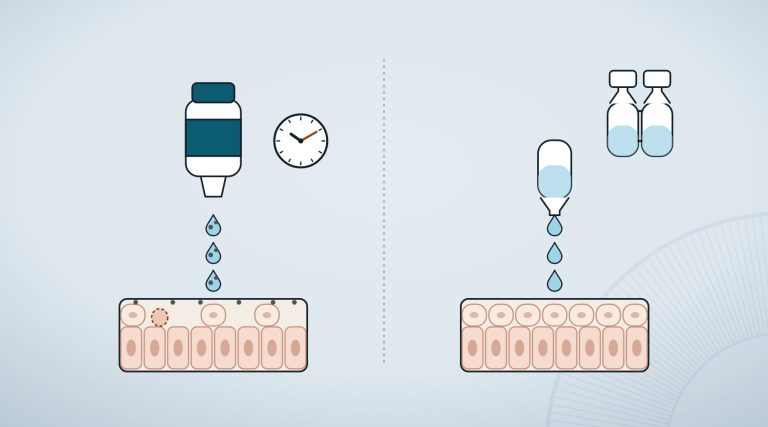
Atropine is an old acquaintance of ophthalmologists. As drops it dilates the pupil and relaxes the muscle that focuses up close, which is why for a long time it was used mainly during examinations. In recent years, at much lower concentrations, it has become one of the most studied treatments for slowing myopia in children.
In 2025 European approval also arrived: after the favourable opinion of the European Medicines Agency, a low-dose atropine eye drop was authorised in the European Union to slow the worsening of myopia in children9. What do the studies on atropine and myopia say, in numbers? And what do we still not know?
In brief
- The LAMP study compared three low concentrations, from 0.01% to 0.05%: the effect grew with the concentration, and with it the effects on the pupil2.
- A Cochrane review of 64 studies concludes that low-dose atropine may slow myopia: in one year, about 0.38 dioptres less worsening compared with control groups, with evidence of very low to moderate certainty1.
- After treatment ends, myopia can start growing faster again: this is the so-called rebound effect3,4.
- European studies on 0.01% have given variable results, from a clear benefit compared with placebo to no difference after three years6,7,8.
- The most common adverse effect of the eye drop authorised in Europe is sensitivity to light9.
In this article
How we measure whether myopia is slowing
Two things are measured in studies of myopia in children. The first is dioptres, that is, by how much myopia increases in a year. The second is the length of the eye, in millimetres, because myopia in children arises mainly from an eye that grows too long, as we explain in the article on what myopia is.
A treatment that ‘works’, in this field, does not take myopia back: it makes it increase less. A critical review from 2025 recalls that percentages (‘slows by 50%’) are a misleading way of measuring efficacy, and that the effect tends to diminish over time10: it is better to look at dioptres and millimetres.
Atropine and myopia: the LAMP study
The reference study is called LAMP: it compared three low concentrations with a placebo and then followed the same children for years2,5.
The study
LAMP: three concentrations compared with a drug-free eye drop
The study randomly assigned 438 children aged 4 to 12, with at least one dioptre of myopia, to atropine at 0.05%, at 0.025%, at 0.01% or to a drug-free eye drop (placebo); neither the families nor the researchers knew who received what. After one year myopia had increased on average by 0.27 dioptres with 0.05%, by 0.46 with 0.025%, by 0.59 with 0.01% and by 0.81 with placebo; the eye had lengthened by 0.20, 0.29, 0.36 and 0.41 millimetres respectively. With the highest concentration the pupil, in full light, widened on average by about a millimetre and the ability to focus up close was reduced more; visual acuity and vision-related quality of life, however, did not change in any group2. The limitations: one year’s duration in this first phase, and a single population, that of Chinese children2,3.
How much it slows, according to the Cochrane review
The overall picture comes from a 2023 Cochrane systematic review, of the ‘living’ type, that is, updated as new studies come out. It brought together 64 randomised trials with 11,617 children and teenagers aged 4 to 18, 61% of them conducted in China or other Asian countries1.
In the control groups myopia increased by 0.65 dioptres in a year (median value). With low-dose atropine this increase was about 0.38 dioptres smaller, and at two years the difference was 0.24 dioptres; the eye lengthened by 0.13 millimetres less at one year and by 0.16 at two years1. Higher concentrations slowed it more, but already among the low concentrations the effects on the pupil and on focusing grow with the dose1,2.
The authors are cautious: the certainty of the evidence ranges from very low to moderate, data beyond two years are few, the effect in the long term is uncertain and adverse effects were not reported uniformly1.
The rebound effect: what happens after stopping
In the third year of the LAMP study some of the children continued the drops and others moved to a period without. In those who had used 0.05%, that year myopia increased by 0.68 dioptres in the group without drops against 0.28 in those who had continued3. The rebound was smaller in older children and with the lowest concentrations3.
After five years, among the children who had never stopped, those who started on 0.05% had accumulated on average 1.34 dioptres of myopia, against 1.97 for those who started on 0.025% and 2.34 for those who started on 0.01%4. Among those who had stopped in the third year, with the idea of resuming only in case of new worsening, 88% then had to start again4. The latest chapter, published in 2026 after eight years, compared two ways of finishing: reducing the drops gradually or stopping suddenly. Over the following three years myopia grew by 0.54 dioptres with gradual reduction and by 0.78 with an abrupt stop, with more marked differences in younger and more myopic children5.
Measuring the rebound, however, is less simple than it seems, and the Cochrane review still judges the evidence on this point inconclusive1,10.
European studies and the Union’s approval
Most studies come from Asia1, and the European ones of recent years have given less uniform results.
In the United Kingdom the CHAMP-UK study involved 289 children aged 6 to 12 in five centres, 72% of them of white origin, randomly assigned to atropine at 0.01% or to placebo. Atropine reduced the worsening by 0.33 dioptres and the lengthening of the eye by 0.14 millimetres, with no differences between age groups, origin or sex; the pupil was on average 0.36 millimetres larger and adverse events were not more frequent than with placebo6.
Another European study, of 250 children, found after two years no significant difference in dioptres, although with an eye that lengthened a little less (0.07 millimetres); the effect varied with origin and eye colour7. In Denmark, after three years, including a final period without drops, the differences from placebo were no longer significant8. On the lowest concentration opinions remain divided: the 2025 critical review concludes that 0.01% should not be considered a first-choice treatment10.
The 2025 European decision is based on a study of 852 children aged 3 to 14 followed for 24 months. In children whose myopia was worsening by at least half a dioptre a year, it increased by 0.34 dioptres with the eye drop and by 0.54 with placebo9. The authorisation covers children aged 3 to 14 with myopia between −0.5 and −6 dioptres that is worsening by at least half a dioptre a year9.
Adverse effects: what is known
Atropine dilates the pupil and slightly reduces focusing up close: this is where the most frequent effects come from. For the eye drop authorised in Europe the most common adverse effect is sensitivity to light, which affects more than one child in ten; eye irritation and blurred vision affect up to one child in ten9. In the British study there were no serious adverse events linked to the eye drop6.
When to talk to an ophthalmologist
- If a child who uses drops for myopia has discomfort in light that does not go away, struggles to read up close or often has red, irritated eyes9.
- If myopia keeps increasing quickly between one check-up and the next: choices about a treatment are assessed with whoever follows the child.
Frequently asked questions
Does atropine make myopia go away?
No. In the studies it slows the increase in myopia and the lengthening of the eye, but does not take back the dioptres already present1,2. To see well in the distance the child still needs glasses or lenses.
What is the difference between atropine at 0.01% and at 0.05%?
In the LAMP study 0.05% slowed myopia more: after five years of continuous treatment, the children who started on 0.05% had an increase of 1.34 dioptres, those who started on 0.01% 2.344. With higher concentrations, however, the effects on the pupil and on focusing up close also grow2. In European studies 0.01% has given variable results6,7,8.
For how long has atropine against myopia been studied?
Randomised trials mostly last from one to three years1; LAMP followed children for eight years5. After treatment ends a rebound is possible, smaller in older children3.
Is atropine against myopia authorised in Europe?
Yes: since 2025 a low-dose atropine eye drop has been authorised in the European Union to slow myopia in children aged 3 to 149. Availability and reimbursement vary from country to country: it is a question for the ophthalmologist.
In Europe low-dose atropine has moved beyond the experimental stage9. The studies say that it slows myopia, not that it stops it; that the effect changes from one population to another; and that after stopping there may be a rebound1,3,7. Alongside the drops, lenses and glasses for myopia are being studied and, even before that, time outdoors.
Sources
- Lawrenson JG, Shah R, Huntjens B, Downie LE, Virgili G, Dhakal R, et al. Interventions for myopia control in children: a living systematic review and network meta-analysis. Cochrane Database Syst Rev. 2023;2(2):CD014758. doi:10.1002/14651858.CD014758.pub2 · PubMed 36809645 · PMC
- Yam JC, Jiang Y, Tang SM, Law AKP, Chan JJ, Wong E, et al. Low-Concentration Atropine for Myopia Progression (LAMP) Study: A Randomized, Double-Blinded, Placebo-Controlled Trial of 0.05%, 0.025%, and 0.01% Atropine Eye Drops in Myopia Control. Ophthalmology. 2019;126(1):113-124. doi:10.1016/j.ophtha.2018.05.029 · PubMed 30514630
- Yam JC, Zhang XJ, Zhang Y, Wang YM, Tang SM, Li FF, et al. Three-Year Clinical Trial of Low-Concentration Atropine for Myopia Progression (LAMP) Study: Continued Versus Washout: Phase 3 Report. Ophthalmology. 2022;129(3):308-321. doi:10.1016/j.ophtha.2021.10.002 · PubMed 34627809
- Zhang XJ, Zhang Y, Yip BHK, Kam KW, Tang F, Ling X, et al. Five-Year Clinical Trial of the Low-Concentration Atropine for Myopia Progression (LAMP) Study: Phase 4 Report. Ophthalmology. 2024;131(9):1011-1020. doi:10.1016/j.ophtha.2024.03.013 · PubMed 38494130
- Zhang Y, Zhang XJ, Zaabaar E, Yim CC, Yip BHK, Kam KW, et al. Discontinuation Approach and Follow-Up of Low-Concentration Atropine for Myopia Progression: Eight-Year Results of the LAMP Randomized Clinical Trial. JAMA Ophthalmol. 2026;144(5):396-403. doi:10.1001/jamaophthalmol.2026.0436 · PubMed 41885837 · PMC
- Azuara-Blanco A, Logan NS, McConnell E, Kearney S, Kirk G, Jones S, et al. Low concentration atropine eye drops and progression of myopia in children: multicentre placebo controlled, double masked, randomised trial in the UK (CHAMP-UK). BMJ. 2026;393:e086698. doi:10.1136/bmj-2025-086698 · PubMed 42276557 · PMC
- Loughman J, Kobia-Acquah E, Lingham G, Butler J, Loskutova E, Mackey DA, et al. Myopia outcome study of atropine in children: Two-year result of daily 0.01% atropine in a European population. Acta Ophthalmol. 2024;102(3):e245-e256. doi:10.1111/aos.15761 · PubMed 37694816
- Hansen N, Hvid-Hansen A, Møller F, Bek T, Larsen D, Jacobsen N, et al. 3-year results of 0.01% and 0.1% loading dose atropine treatment including washout in Danish children with myopia: a placebo-controlled, randomised clinical trial. Br J Ophthalmol. 2025;109(9):1056-1063. doi:10.1136/bjo-2024-326918 · PubMed 40122578 · PMC
- Agenzia europea per i medicinali (EMA). Valutazione pubblica europea (EPAR): atropina a basso dosaggio per rallentare la miopia nei bambini. 2025. ema.europa.eu
- Brennan NA, Cheng X, Jong M, Bullimore MA. Commonly Held Beliefs About Myopia That Lack a Robust Evidence Base: 2025 Update. Eye Contact Lens. 2025;51(8):319-335. doi:10.1097/ICL.0000000000001191 · PubMed 40397787
Study titles are given in their original language of publication. The superscript numbers in the text refer to these sources; citation details come from PubMed (National Library of Medicine).