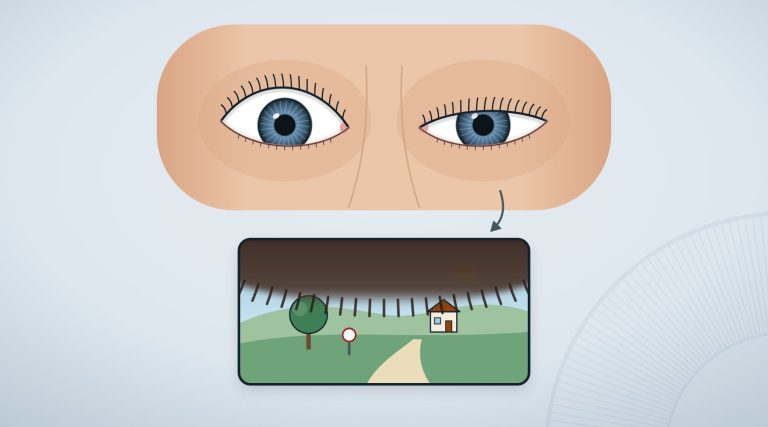
An eye turns red within a day, it hurts, and the light from a window is enough to make it water. The first thought, usually, is conjunctivitis. Sometimes, however, the inflammation does not involve the surface of the eye but its interior: it is called uveitis, and its typical symptoms are precisely a red eye, pain, discomfort in light, ‘floaters’ and blurred vision1.
It affects mainly adults between 20 and 50 and often does not stay confined to the eye: in Europe and the United States, 37 to 49% of cases are associated with a disease of the whole body, such as spondyloarthritis1.
In brief
- Uveitis is an inflammation of the uvea, the middle layer of the eye made up of the iris, ciliary body and choroid; it affects mainly people between 20 and 501.
- It can cause a red eye, pain, discomfort in light, floaters and blurred vision; in children, by contrast, it often gives no symptoms1,8.
- It is classified according to where the inflammation is: anterior, intermediate, posterior or spread throughout the eye3.
- It is more frequent in people with ankylosing spondylitis, juvenile idiopathic arthritis or sarcoidosis6,9.
- Without treatment it can lead to cataract, glaucoma, macular oedema and loss of vision; treatments aim to put out the inflammation while using as little cortisone as possible1.
In this article
What uveitis is
The uvea is the middle layer of the wall of the eye. It includes the iris, the coloured part; the ciliary body, which produces the fluid inside the eye; and the choroid, the network of vessels that nourishes the retina1.
Uveitis is the name of a family of diseases. The causes can be infectious, such as toxoplasmosis or herpes, or non-infectious, linked to the immune system; in high-income countries infectious uveitis is a minority, in middle- and low-income ones it reaches about half of cases. In Europe and the United States, 27 to 51% of uveitis remains without a recognisable cause1.
How many people suffer from it is hard to say. A 2021 systematic review pooled 49 studies: estimates ranged from 9 to 730 cases per 100,000 people, depending on the country and the way of counting, and the mean incidence was about 50 new cases per 100,000. The authors warn that many studies are not very representative2.
Anterior, intermediate, posterior: how it is classified
In 2005 an international group of specialists, the Standardization of Uveitis Nomenclature (SUN), established that uveitis should be classified first of all according to where the inflammation is, and not according to complications; it also set common scales for measuring how intense it is, counting for example the inflammatory cells in the front part of the eye3.
| Form | Where the inflammation is | Share of cases |
|---|---|---|
| Anterior | Iris and ciliary body | 41 to 60% |
| Intermediate | Peripheral part of the ciliary body and retina | 9 to 15% |
| Posterior | Choroid and/or retina | 17 to 23% |
| Panuveitis | All layers of the uvea | 7 to 32% |
The data in the table come from a 2025 review1. In 2021 the SUN group published classification criteria for 25 types of uveitis, built by analysing 5,766 cases with machine learning techniques: in validation they assigned the right diagnosis between 93.3 and 99.3% of the time, depending on the form. They are designed mainly for research4.
Uveitis: the symptoms to recognise
The symptoms listed by the reviews are five: red eye, pain, discomfort in light, floaters and blurred vision1. They do not always appear all together.
When the eye is red, what accompanies it matters. A review of cases seen in the emergency department sums it up like this: a red eye without discomfort in light, without pain and without visual disturbance is most often conjunctivitis; the presence of even just one of these symptoms is a reason to look for a more serious cause10. We also discuss this in the article on the red eye.
The best-known form is acute anterior uveitis linked to HLA-B27, a genetic characteristic. A meta-analysis of 22 studies found that this form affects men more often, usually involves one eye only or one eye at a time, in alternating episodes, and can form a whitish deposit of inflammatory cells in the front part of the eye5.
In children the picture is different. A 2022 review points out that uveitis in childhood, 5–10% of all cases, is often without symptoms: it can become chronic and damage the eye before anyone notices, with cataract, glaucoma and lazy eye among the complications8.
The link with autoimmune diseases
A meta-analysis published in 2026, which pooled 106 studies, estimated how frequent non-infectious uveitis is in different groups of people. In adults in general the frequency was about 132 cases per 100,000 people; in some diseases, however, the numbers change scale6:
- in ankylosing spondylitis, the inflammatory disease of the spine, about 18 people in 100;
- in undifferentiated spondyloarthritis, those that do not fall into a precise form, about 15 in 100;
- in juvenile idiopathic arthritis, the most common childhood arthritis, about 13 in 100;
- in psoriatic arthritis, about 3 in 100.
Behçet’s disease is also among the conditions with the most uveitis6. In spondyloarthritis uveitis is the most frequent manifestation outside the joints7.
The eye sometimes comes before the diagnosis. A meta-analysis of 14 studies on over 16,000 people with spondyloarthritis found that those who had had uveitis waited on average 6.1 years for the diagnosis of the rheumatic disease, against 5.4 years for those who had not, and often had more active disease7.
In sarcoidosis, which forms small inflammatory nodules in various organs, the eyes are involved in 20 to 50% of cases. Uveitis can appear even when the disease has not yet shown itself elsewhere, and it usually responds to corticosteroids9.
How it is treated: the routes indicated by studies
Treatment depends on the form and the cause, and the stated aim is twofold: to put out the inflammation and keep it out, using cortisone as little as possible to limit its side effects1. A 2025 review sums them up like this1:
- infectious uveitis requires drugs against the responsible microorganism, taken for the whole body;
- non-infectious anterior uveitis is usually treated with cortisone eye drops;
- mild intermediate forms can be kept under observation without initial therapy;
- moderate or severe intermediate, posterior and diffuse forms have a high risk of complications for vision and require corticosteroids by mouth, intravenously or inside the eye, and immunosuppressive drugs.
In posterior uveitis, first-choice immunosuppressive drugs put out or controlled the inflammation in between 52 and 71% of patients, depending on the drug. In those who did not improve, a biological anti-TNF drug, adalimumab, reduced the share of people in whom treatment failed from 78.5% with placebo to 54.5%1. When there is an active general disease, such as spondyloarthritis, it should also be followed by the specialist in that disease, for example the rheumatologist1.
An important clarification concerns cortisone drops: a review for emergency doctors indicates using them for a red eye only when the diagnosis is certain and after the ophthalmologist’s opinion10. In infectious uveitis, in fact, the treatment is different1.
When to talk to an ophthalmologist
- Red eye with pain, discomfort in light or blurred vision: these are the signs that distinguish the more serious causes from conjunctivitis1,10. Talk to the ophthalmologist soon, the same day if the pain is severe or vision is getting worse.
- If you have ankylosing spondylitis, psoriatic arthritis or another spondyloarthritis and a red, painful eye appears: in these diseases uveitis is frequent6,7.
- If a child has juvenile idiopathic arthritis: uveitis may give no symptoms at all, and eye check-ups are agreed with whoever follows them8.
- If many floaters appear suddenly or vision becomes blurred1: the possible causes are several, as we explain in the article on floaters.
- Immediately: a sudden and marked drop in vision. Call 112 or go to an emergency department (A&E); you will find the other warning signs on our page about eye emergencies.
Frequently asked questions
Is uveitis contagious?
Not like conjunctivitis: the inflammation is inside the eye and, in most European cases, is not due to an infection but to the immune system1. When the cause is an infection, such as toxoplasmosis or herpes, it is treated with drugs against that microorganism1.
Can uveitis cause loss of vision?
It can happen if it is not treated: the possible complications are cataract, glaucoma, macular oedema, retinal detachment and damage to the optic nerve1. In children there is the added risk of lazy eye8. We discuss the complications on eye pressure in the article on glaucoma.
Uveitis and ankylosing spondylitis: how often do they go together?
According to a 2026 meta-analysis, about 18 people in 100 with ankylosing spondylitis have uveitis6. The link is particularly strong for acute anterior uveitis in people with HLA-B27, a genetic characteristic5.
Does uveitis come back?
It can come back: this is why the aim of treatment is not only to put out the inflammation but to keep it out over time1. Forms linked to HLA-B27, for example, can affect one eye at a time, in alternating episodes5, and in children the inflammation can flare up again even during treatment8.
Uveitis is an inflammation inside the eye, and in many cases a warning sign of something that involves the whole body1,6. Its symptoms resemble those of more trivial problems, but the pain, discomfort in light and blurred vision make the difference10. Recognising it early matters twice over: to avoid its complications and, sometimes, to reach the diagnosis of a rheumatic disease sooner1,7.
Sources
- Maghsoudlou P, Epps SJ, Guly CM, Dick AD. Uveitis in Adults: A Review. JAMA. 2025;334(5):419-434. doi:10.1001/jama.2025.4358 · PubMed 40434762
- García-Aparicio Á, García de Yébenes MJ, Otón T, Muñoz-Fernández S. Prevalence and Incidence of Uveitis: A Systematic Review and Meta-analysis. Ophthalmic Epidemiol. 2021;28(6):461-468. doi:10.1080/09286586.2021.1882506 · PubMed 33557663
- Jabs DA, Nussenblatt RB, Rosenbaum JT, Standardization of Uveitis Nomenclature (SUN) Working Group. Standardization of uveitis nomenclature for reporting clinical data. Results of the First International Workshop. Am J Ophthalmol. 2005;140(3):509-16. doi:10.1016/j.ajo.2005.03.057 · PubMed 16196117 · PMC
- Standardization of Uveitis Nomenclature (SUN) Working Group. Development of Classification Criteria for the Uveitides. Am J Ophthalmol. 2021;228:96-105. doi:10.1016/j.ajo.2021.03.061 · PubMed 33848532 · PMC
- D’Ambrosio EM, La Cava M, Tortorella P, Gharbiya M, Campanella M, Iannetti L. Clinical Features and Complications of the HLA-B27-associated Acute Anterior Uveitis: A Metanalysis. Semin Ophthalmol. 2017;32(6):689-701. doi:10.3109/08820538.2016.1170158 · PubMed 27404944
- Sriranganathan A, Stasso J, Miranda RN, Felfeli T. INCIDENCE AND PREVALENCE OF NONINFECTIOUS UVEITIS: A Systematic Review and Meta-Analysis. Retina. 2026;46(8):1325-1336. doi:10.1097/IAE.0000000000004812 · PubMed 41791034
- Lee SC, Yang CH, Tsai YC, Yu KH. The effect of uveitis and undiagnosed spondyloarthritis: a systematic review and meta-analysis. Sci Rep. 2023;13(1):14779. doi:10.1038/s41598-023-41971-z · PubMed 37679498 · PMC
- Maleki A, Anesi SD, Look-Why S, Manhapra A, Foster CS. Pediatric uveitis: A comprehensive review. Surv Ophthalmol. 2022;67(2):510-529. doi:10.1016/j.survophthal.2021.06.006 · PubMed 34181974
- Salah S, Abad S, Brézin AP, Monnet D. [Sarcoidosis]. J Fr Ophtalmol. 2019;42(3):303-321. doi:10.1016/j.jfo.2018.06.015 · PubMed 30850198
- Bertolini J, Pelucio M. The red eye. Emerg Med Clin North Am. 1995;13(3):561-79. PubMed 7635083
Study titles are given in their original language of publication. The superscript numbers in the text refer to these sources; citation details come from PubMed (National Library of Medicine).